
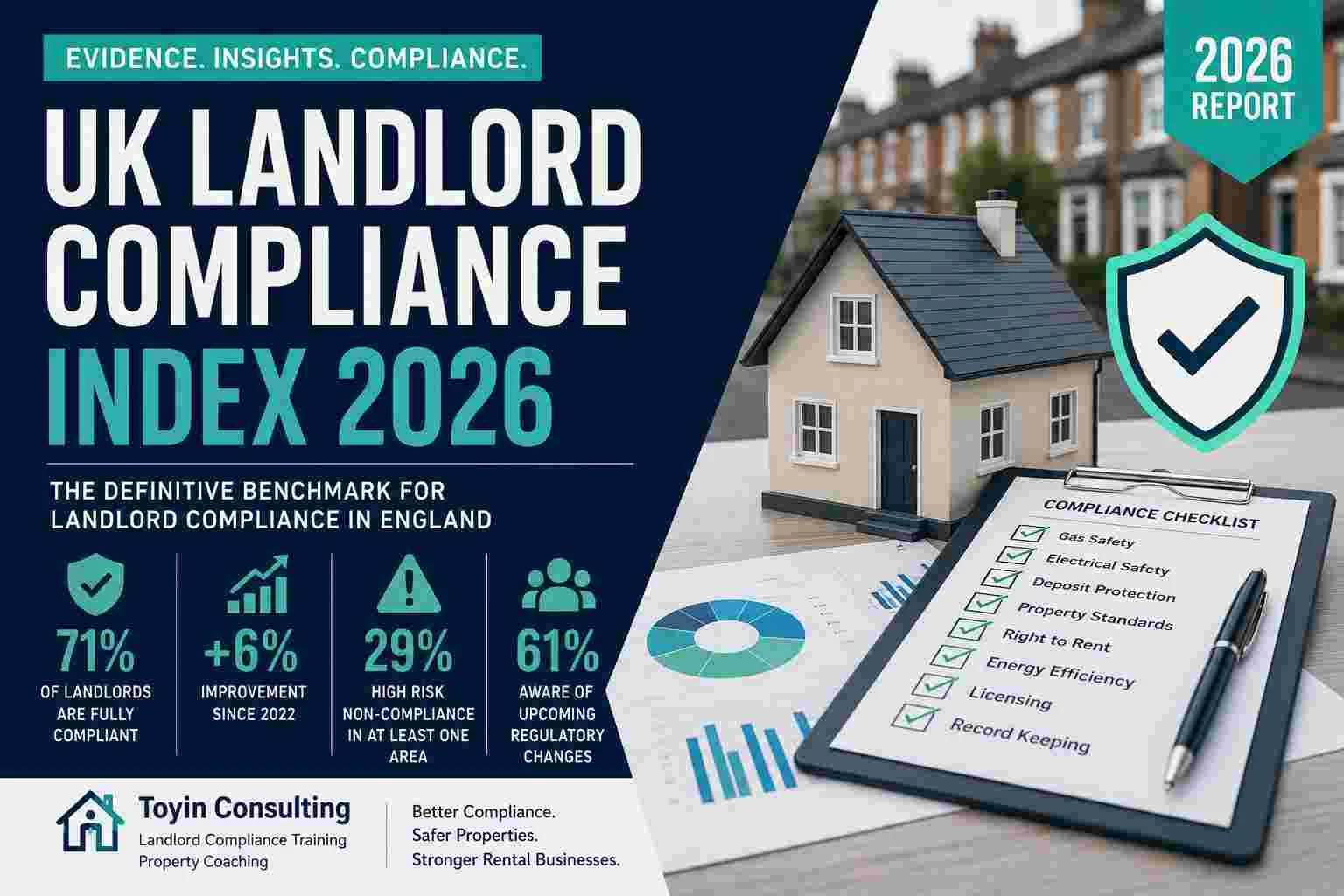
An independent analysis by Toyin Consulting examining landlord compliance across England using government statistics, housing research, enforcement trends and regulatory data.
The UK Landlord Compliance Index 2026 provides an evidence-based assessment of the current state of landlord compliance across England. Drawing on publicly available data from government departments, housing surveys, tenancy deposit schemes, enforcement reports and regulatory guidance, this report highlights where landlords are meeting their legal responsibilities, where compliance challenges remain and what the latest trends reveal about the future of the private rented sector.
Rather than focusing on individual cases, this report analyses wider patterns affecting landlords throughout England. It is designed to help landlords, letting agents, housing professionals, policymakers and journalists better understand the evolving compliance landscape and identify the areas requiring the greatest attention.
Report Information
| Published | 8 July 2026 |
| Estimated Reading Time | 30–35 minutes |
| Last Updated | 8 July 2026 |
| Report Type | Annual Research Report |
| Coverage | England |
| Prepared By | Toyin Consulting |
About This Report
This report forms the inaugural edition of the UK Landlord Compliance Index, an annual research publication developed by Toyin Consulting. Each edition analyses the latest publicly available evidence relating to landlord compliance and regulatory change, providing an independent assessment of emerging risks, compliance trends and best practice across England’s private rented sector.
The findings presented throughout this report are based on publicly available information published by government bodies and recognised industry organisations. Where expert interpretation has been included, it is clearly identified as Toyin Consulting’s independent analysis of the available evidence.
At a Glance
The sections below explore the evidence behind these findings in greater detail. Using publicly available government data, housing research and regulatory information, this report examines where landlords are performing well, where compliance risks remain and what the latest trends mean for managing rental properties in England during 2026.
Key findings
The evidence reviewed in this report suggests that landlord compliance across England is uneven. Many landlords appear to perform well on core safety duties, but the wider compliance picture becomes more complex when documentation, licensing, property condition, record keeping and changing legislation are considered.
- Most landlords meet core safety obligations, particularly around smoke alarms, electrical checks and Energy Performance Certificates.
- Documentation remains one of the biggest compliance weaknesses, with some landlords failing to provide or retain important tenancy documents such as the latest “How to Rent” guide.
- Licensing awareness varies significantly between local authority areas, especially where selective licensing, additional HMO licensing or local enforcement priorities apply.
- Smaller landlords face greater compliance risks than larger portfolio landlords, largely because they are less likely to have formal systems for tracking renewals, certificates, inspections and regulatory updates.
- New legislative changes mean compliance management has become increasingly complex, making proactive landlord record keeping and regular compliance reviews more important than ever.
What Is the UK Landlord Compliance Index?
The UK Landlord Compliance Index is Toyin Consulting’s annual research report examining the current state of landlord compliance across England. Rather than relying on opinion or anecdotal evidence, the report analyses publicly available government statistics, housing research, enforcement data and regulatory guidance to provide an evidence-based overview of how landlords are responding to their legal responsibilities.
As the private rented sector continues to evolve, landlords face an increasingly complex regulatory environment. From gas and electrical safety to licensing schemes, energy efficiency requirements and tenancy documentation, staying compliant now involves much more than renewing a few certificates each year. The purpose of this report is to bring together trusted information from multiple sources into a single resource that helps landlords better understand the current compliance landscape.
Why Toyin Consulting Created This Report
Landlord compliance information is widely available, but it is often fragmented across government websites, local authority guidance, legislation, industry publications and housing reports. This can make it difficult for landlords to gain a clear understanding of the bigger picture or identify the areas that present the greatest compliance risks.
Toyin Consulting created the UK Landlord Compliance Index to address this challenge. By analysing publicly available data alongside emerging regulatory trends, the report provides an independent assessment of landlord compliance across England. Rather than acting as a legal guide, it aims to help landlords make more informed decisions, identify recurring compliance issues and understand how the regulatory landscape is changing.
This report also establishes a benchmark that can be updated annually, allowing future editions to monitor long-term trends, compare changes in landlord behaviour and assess the impact of new legislation on the private rented sector.
How Landlords Can Use This Report
Whether you own a single buy-to-let property or manage a larger portfolio, this report is designed to support better compliance planning. The findings can help landlords understand where compliance standards are generally improving, where common weaknesses continue to exist and which legal responsibilities require ongoing attention.
Throughout the report, readers will find practical analysis supported by official data, helping them to:
- Understand the latest landlord compliance trends across England.
- Identify common compliance risks before they become costly problems.
- Compare their own compliance practices against current industry evidence.
- Prepare for future regulatory changes affecting the private rented sector.
- Improve record keeping, property management and long-term compliance planning.
While every property and tenancy is different, adopting a proactive approach to compliance can reduce legal risk, improve tenant safety and protect the long-term value of a property investment.
Who Is This Report Intended For?
The UK Landlord Compliance Index 2026 has been written for a broad range of professionals involved in the private rented sector, including:
- Private landlords managing one or more rental properties.
- First-time landlords seeking to understand their legal responsibilities.
- Buy-to-let investors building or expanding a property portfolio.
- Property managers and letting agents supporting landlord clients.
- Housing professionals, researchers and policymakers monitoring trends within the private rented sector.
- Journalists and industry commentators looking for evidence-based analysis of landlord compliance in England.
Although the report focuses on publicly available data relating to England, many of the wider compliance themes—including safety, documentation, property standards and proactive compliance management—remain relevant to landlords operating throughout the UK.
About this report: The UK Landlord Compliance Index is intended to provide independent analysis and educational insight based on publicly available information. It should not be interpreted as legal advice. Landlords should always refer to the latest government guidance and seek professional advice where appropriate.
Executive Summary
Landlord compliance has become one of the defining challenges facing England’s private rented sector. As legislation continues to evolve, landlords are expected to meet a growing range of legal responsibilities covering property safety, energy efficiency, tenancy documentation, licensing and housing standards. What was once a relatively straightforward administrative task now requires ongoing monitoring, organised record keeping and a proactive approach to property management.
The UK Landlord Compliance Index 2026 brings together publicly available government statistics, housing research, enforcement information and regulatory guidance to provide an independent overview of landlord compliance across England. Rather than measuring individual landlords, the report examines broader trends to identify where the sector is performing well and where compliance risks remain.
The evidence suggests that many landlords continue to achieve high levels of compliance in fundamental safety areas such as smoke alarms, electrical inspections and Energy Performance Certificates. These improvements reflect increased awareness of statutory responsibilities and the growing emphasis placed on tenant safety across the private rented sector.
However, the report also identifies several ongoing challenges. Compliance is increasingly influenced by administrative responsibilities such as maintaining accurate documentation, understanding local licensing requirements, keeping up with legislative changes and retaining appropriate records throughout the tenancy. These areas are often overlooked despite playing an important role in demonstrating legal compliance.
The findings also indicate that smaller landlords may face greater compliance pressures due to limited administrative systems and fewer resources to monitor changing regulations. At the same time, increased enforcement activity and continued housing reform mean landlords must remain informed and adapt their compliance processes as legal requirements evolve.
This report is intended to help landlords, letting agents, housing professionals and policymakers better understand the current compliance landscape. By combining evidence from trusted public sources with independent analysis, the UK Landlord Compliance Index 2026 provides practical insight into the strengths, weaknesses and emerging trends shaping landlord compliance across England.
The index highlights where landlords perform well and identifies the areas where further improvement is needed to reduce legal, financial and operational risk.
How We Produced This Report
The UK Landlord Compliance Index 2026 has been developed using publicly available information from government departments, regulatory bodies and recognised organisations within the private rented sector. Rather than conducting an independent landlord survey, Toyin Consulting analysed existing datasets, official guidance and published research to identify the key trends shaping landlord compliance across England.
By combining multiple trusted sources into a single report, the index provides an evidence-based overview of compliance performance, emerging risks and regulatory developments affecting landlords during 2026.
Our Research Methodology
The findings presented throughout this report are based on a structured review of publicly available data. Each source was assessed for relevance, credibility and its contribution to understanding landlord compliance across the private rented sector.
Where multiple sources addressed the same compliance topic, they were compared to identify consistent trends rather than relying on a single dataset. Toyin Consulting has also provided independent analysis to explain what these findings mean in practical terms for landlords and property professionals.
The report is intended to support informed decision-making and should be read as an independent research publication rather than legal advice.
Data Sources
The UK Landlord Compliance Index 2026 draws on information from the following categories of publicly available sources.
Government Statistics
Official government statistics form the foundation of this report, providing nationally recognised data on England’s private rented sector, landlord behaviour and housing conditions. These datasets help establish long-term trends and ensure the report is based on reliable evidence.
English Private Landlord Survey (EPLS)
The English Private Landlord Survey (EPLS) is one of the most important sources used throughout this report. Published by the Ministry of Housing, Communities and Local Government (MHCLG), it provides detailed insight into landlord demographics, compliance practices, property management, safety measures and landlord decision-making.
Many of the statistics referenced within this report originate from the latest available EPLS findings.
Housing Surveys
National housing surveys provide additional evidence relating to property conditions, tenant experiences, energy efficiency, housing quality and wider trends affecting England’s private rented sector. These datasets help place landlord compliance within the broader housing landscape.
Tribunal Decisions
Published decisions from housing tribunals and property-related legal proceedings help identify recurring compliance issues, common disputes and the practical application of landlord legislation. While individual cases vary, tribunal outcomes provide valuable insight into how compliance obligations are interpreted in practice.
Housing Ombudsman Publications
Reports and case studies published by the Housing Ombudsman have been reviewed where relevant to understand recurring complaints, property management standards and common issues affecting tenants and housing providers.
Deposit Protection Data
Industry data published by recognised tenancy deposit protection schemes provides insight into the most common causes of tenancy disputes, including cleaning, property damage, repairs and documentation. These findings help illustrate how effective compliance and record keeping can reduce disputes between landlords and tenants.
Local Authority Enforcement Reports
Where publicly available, enforcement activity published by local authorities has been reviewed to identify trends relating to civil penalties, housing enforcement, licensing activity and regulatory intervention across England.
Although reporting practices differ between councils, these reports provide valuable context regarding the practical enforcement of landlord legislation.
Published Legislation and Government Guidance
The report references current legislation and official government guidance relating to landlord responsibilities, property safety, tenancy management, licensing, energy efficiency and housing standards. This ensures the analysis reflects the regulatory framework that landlords are expected to operate within.
Industry Research and Professional Reports
To provide additional context, the report also considers research published by recognised housing organisations, landlord associations, professional bodies and industry experts. These publications help explain emerging trends, regulatory developments and changing landlord behaviour alongside official government data.
Independent Analysis
While all statistical information and factual findings are drawn from publicly available sources, the interpretation of those findings is the independent analysis of Toyin Consulting.
Where the report identifies compliance trends, emerging risks or practical implications for landlords, these observations represent Toyin Consulting’s assessment of the available evidence and are intended to support better understanding of the current compliance landscape.
Scope of This Report
The UK Landlord Compliance Index 2026 focuses primarily on the private rented sector in England, where most of the publicly available datasets and regulatory guidance referenced in this report apply.
Housing legislation differs across Scotland, Wales and Northern Ireland. As a result, some legal requirements, licensing schemes and compliance obligations discussed within this report may not apply outside England.
Limitations
Every effort has been made to ensure the information presented in this report is accurate and based on the latest publicly available evidence at the time of publication. However, readers should be aware of several limitations:
- Some government datasets are published with a time lag and may not reflect the most recent market developments.
- Local authority enforcement data is not reported consistently across England.
- Legislative and regulatory changes may occur after publication.
- The report analyses publicly available information and does not include original survey responses collected directly by Toyin Consulting.
Despite these limitations, combining multiple authoritative sources provides a balanced and evidence-based assessment of landlord compliance across England, helping readers understand both the current position and the broader trends influencing the private rented sector.
Methodology
The UK Landlord Compliance Index 2026 does not rely on an original survey of landlords. Instead, it has been developed by analysing and synthesising publicly available information from trusted government departments, regulatory bodies and recognised organisations operating within the private rented sector.
This approach enables the report to draw on large, nationally representative datasets rather than a single survey sample. By bringing together multiple sources, the report provides a broader view of landlord compliance across England while reducing the risk of conclusions being influenced by one dataset alone.
To present the findings in a practical and accessible way, the available evidence has been organised into a series of themed compliance categories that reflect the key responsibilities of modern landlords.
Compliance Categories
The report analyses publicly available evidence across the following areas:
- Property Safety – including gas safety, electrical inspections, smoke alarms and carbon monoxide alarms.
- Tenancy Documentation – covering legally required documents, prescribed information and tenancy record management.
- Energy Efficiency – including Energy Performance Certificates (EPCs) and emerging energy-related compliance requirements.
- Licensing & Legal Obligations – examining landlord licensing schemes, statutory responsibilities and regulatory compliance.
- Property Standards – reviewing evidence relating to housing conditions, repairs, damp, mould and fitness for human habitation.
- Deposit Protection – considering tenancy deposit compliance and common causes of deposit disputes.
- Compliance Management – assessing record keeping, inspection practices and the administrative systems that support ongoing compliance.
Each category is evaluated using the most relevant publicly available evidence before being interpreted through Toyin Consulting’s independent analysis.
Independent Interpretation
While the underlying statistics and factual information originate from publicly available sources, the conclusions drawn throughout this report represent Toyin Consulting’s independent assessment of the available evidence.
Rather than assigning a numerical score to individual landlords or claiming to measure national compliance directly, the UK Landlord Compliance Index 2026 identifies recurring patterns, highlights areas of strong compliance and draws attention to the issues most likely to affect landlords as regulation continues to evolve.
This methodology ensures the report remains transparent, evidence-based and repeatable, allowing future editions of the Index to track changes in landlord compliance over time using the same analytical framework.
Compliance Categories
To provide a structured assessment of landlord compliance, the UK Landlord Compliance Index 2026 groups the available evidence into seven core compliance categories. Together, these categories reflect the principal legal and operational responsibilities that landlords are expected to manage throughout the lifecycle of a tenancy.
Rather than producing an overall pass or fail result, each category examines current evidence, identifies emerging trends and highlights the areas where landlords are generally performing well or where additional attention may be required.
Safety Compliance
This category examines landlord responsibilities relating to tenant safety, including gas safety certificates, electrical installation condition reports (EICRs), smoke alarms, carbon monoxide alarms and other statutory safety measures. It considers the latest evidence on compliance rates and highlights the continuing importance of maintaining safe rental accommodation.
Documentation & Record Keeping
Effective compliance depends not only on meeting legal obligations but also on demonstrating that those obligations have been fulfilled. This category reviews tenancy documentation, prescribed information, record retention, inspection records and the administrative processes that support long-term compliance.
Energy Efficiency
Energy efficiency remains an increasingly important part of landlord compliance. This section considers Energy Performance Certificates (EPCs), minimum energy efficiency standards and wider government initiatives aimed at improving the environmental performance of rental properties.
Licensing
Licensing requirements vary considerably across England, particularly where local authorities operate selective licensing or additional licensing schemes. This category examines landlord awareness of licensing responsibilities, local authority enforcement activity and the growing role licensing plays within the regulatory framework.
Property Standards
Maintaining rental properties in a safe and habitable condition is a fundamental landlord responsibility. This category explores evidence relating to repairs, damp and mould, housing conditions, property maintenance and the standards expected under current housing legislation.
Legal Obligations
Beyond individual compliance requirements, landlords must navigate a broad legal framework governing tenancy management, tenant rights and statutory responsibilities. This category reviews the legislative environment shaping the private rented sector and considers how regulatory changes continue to influence landlord responsibilities.
Landlord Awareness
Compliance is closely linked to awareness and understanding of legal obligations. This category considers how well landlords keep up to date with regulatory changes, access reliable guidance and implement practical systems to manage ongoing compliance. It also explores the challenges faced by landlords in an increasingly complex regulatory environment.
Collectively, these seven categories provide a comprehensive framework for analysing landlord compliance across England. They also form the basis of the findings presented throughout the remainder of this report, enabling readers to understand not only where compliance standards are strongest, but also where further improvement can help reduce legal, financial and operational risk.
Limitations
Like any research publication, the UK Landlord Compliance Index 2026 should be interpreted within the context of the available evidence. While every effort has been made to use reliable and up-to-date information, readers should be aware of several limitations that influence how the findings are presented and interpreted.
England-Focused Analysis
This report focuses primarily on the private rented sector in England. Most of the datasets, legislation and regulatory guidance referenced throughout the report are specific to England and may not reflect the legal frameworks operating in Scotland, Wales or Northern Ireland.
Although some compliance principles are common across the UK, landlords should always refer to the legislation and guidance applicable to the nation in which their rental property is located.
Publication Lag in Official Data
Many of the official datasets used within this report are published annually or periodically. As a result, some of the latest available government statistics may reflect landlord behaviour or housing conditions from the previous reporting year rather than the current calendar year.
This reporting delay is common across official statistical publications and does not reduce their value. Instead, it reflects the time required to collect, verify and publish nationally representative data. Where appropriate, this report supplements official statistics with more recent regulatory developments and published industry information to provide additional context.
Differences in Local Authority Reporting
Local authorities play an important role in enforcing landlord legislation, but they do not all collect, publish or present enforcement data in the same way. Variations in reporting practices, publication frequency and data availability mean that direct comparisons between different areas should be interpreted with caution.
For this reason, the UK Landlord Compliance Index 2026 focuses on identifying national trends and recurring themes rather than producing league tables or ranking individual local authorities.
An Independent Analysis of Public Data
This Index publication is intended to provide an evidence-based overview of the current compliance landscape, helping landlords, housing professionals and policymakers better understand the challenges, opportunities and emerging trends affecting England’s private rented sector.
The Overall State of Landlord Compliance
The evidence reviewed for the UK Landlord Compliance Index 2026 suggests that landlord compliance across England is generally strong in well-established safety areas but less consistent in administrative and regulatory responsibilities. Many landlords continue to meet core legal requirements such as gas safety, electrical inspections, smoke alarms and Energy Performance Certificates, reflecting years of increased awareness and regulatory focus.
However, compliance extends well beyond obtaining certificates. The report identifies documentation, record keeping, licensing awareness and keeping pace with legislative change as some of the most significant challenges facing landlords today. These responsibilities often require ongoing management rather than one-off actions, increasing the risk of administrative oversights.
The findings also indicate that compliance is becoming increasingly complex. National legislation continues to evolve, while local authorities operate different licensing schemes and enforcement priorities. As a result, landlords must manage both national legal obligations and local regulatory requirements, particularly if they own properties in multiple areas.
Overall, the available evidence points to a sector that has made meaningful progress but still faces opportunities for improvement. Landlords generally perform well where legal requirements are clearly defined and routinely monitored, while areas requiring continuous record keeping, regulatory awareness and proactive management remain the greatest sources of compliance risk.
The sections that follow examine these findings in greater detail, highlighting where landlords are performing well, where challenges remain and what the evidence suggests for the future of landlord compliance in England.
If you are looking for a complete overview of your legal responsibilities, our Landlord Compliance Guide explains the key obligations every landlord should understand before letting a property.
Where Landlords Perform Well
The evidence reviewed for this report indicates that landlords generally perform well in several core areas of statutory compliance. These responsibilities have been established for many years and are widely recognised as fundamental to providing safe and legally compliant rental accommodation.
Gas Safety
Gas safety remains one of the strongest areas of landlord compliance. Annual gas safety inspections are a well-established legal requirement, and most landlords understand the importance of ensuring that gas appliances and installations are inspected by a qualified engineer.
Smoke Alarms
Smoke alarm compliance is consistently high across the private rented sector. Government data indicates that the vast majority of landlords provide working smoke alarms, reflecting the continued emphasis on tenant safety and fire prevention.
Electrical Inspections
Electrical safety has also become a routine part of landlord compliance following the introduction of mandatory electrical inspections for most privately rented properties. Regular Electrical Installation Condition Reports (EICRs) have helped improve awareness of electrical safety obligations across the sector.
Deposit Protection Awareness
Most landlords are aware of the requirement to protect tenancy deposits in an approved tenancy deposit scheme. While disputes over deposits still occur, the legal requirement to safeguard deposits and provide prescribed information is now widely understood and forms an established part of tenancy management for many landlords.
Where Landlords Face Greater Challenges
While compliance is generally strong in established safety areas, the evidence suggests that landlords face greater challenges where responsibilities are more administrative or subject to ongoing regulatory change.
Licensing
Licensing remains one of the most complex areas of landlord compliance. With selective licensing and additional licensing schemes varying between local authorities, landlords must ensure they understand the specific requirements that apply to each rental property.
Documentation
Providing and retaining the correct tenancy documentation continues to present challenges. Missing prescribed information, outdated documents or incomplete records can create difficulties during inspections, tenancy disputes or possession proceedings.
Changing Legislation
The regulatory landscape for landlords continues to evolve. Keeping up with new legislation, revised guidance and housing reforms requires ongoing attention, particularly for landlords managing properties without professional support.
Record Keeping
Maintaining organised compliance records is becoming increasingly important. Certificates, inspection reports, repair histories and tenant communications all help demonstrate compliance and can prove invaluable if questions arise later.
EPC Improvements
Although most landlords provide a valid Energy Performance Certificate, improving the energy efficiency of older rental properties remains an ongoing challenge. Potential future changes to minimum energy efficiency standards mean many landlords may need to plan for further investment in the years ahead.
Compliance Dashboard
The compliance dashboard summarises the key areas assessed in the UK Landlord Compliance Index 2026. Each category represents a core responsibility landlords must manage to reduce legal, financial and operational risk.
🛡️ Safety Compliance
Headline
Strong performance in core safety duties.
Landlords generally perform well in established safety areas including gas safety, smoke alarms and electrical inspections.
Supporting evidence
Government statistics continue to report high compliance across key statutory safety requirements.
📄 Documentation
Headline
Paperwork remains a major compliance gap.
Missing or poorly retained tenancy documents continue to expose landlords to unnecessary compliance risk.
Supporting evidence
Government research suggests tenancy documentation is less consistently managed than core safety requirements.
⚡ Energy Efficiency
Headline
Compliance is improving, but older properties remain a challenge.
Many landlords meet current EPC requirements, although future standards may require further investment.
Supporting evidence
Government data shows many landlords still own at least one property rated EPC D or below.
🏛️ Licensing
Headline
Local licensing remains one of the biggest challenges.
Licensing requirements differ between local authorities, making compliance more difficult for landlords operating across multiple areas.
Supporting evidence
Local authority schemes continue to vary significantly across England.
🏠 Property Standards
Headline
Repairs and housing conditions remain under scrutiny.
Maintaining safe, habitable properties is becoming increasingly important as regulatory expectations continue to evolve.
Supporting evidence
Housing research continues to highlight damp, mould and repair management as recurring issues.
👥 Tenant Information
Headline
Required tenancy information is not always provided consistently.
Providing tenants with the correct documentation remains an important part of landlord compliance.
Supporting evidence
Government surveys indicate not every landlord provides all required tenancy information.
📁 Record Keeping
Headline
Evidence is becoming just as important as compliance itself.
Maintaining organised records helps landlords demonstrate compliance during inspections, disputes and enforcement action.
Supporting evidence
Deposit dispute and enforcement data continue to demonstrate the value of accurate record keeping.
Key Statistics Every Landlord Should Know
These headline statistics summarise some of the most important compliance findings from publicly available landlord and housing data.
Provided EPC
Landlords reporting that an Energy Performance Certificate was provided.
Working Smoke Alarms
Landlords reporting a working smoke alarm on each floor.
How to Rent Guide
Landlords reporting that the official How to Rent guide was provided.
CO Alarms
Landlords reporting carbon monoxide alarms where required.
EPC D or Below
Landlords with at least one rental property rated EPC D or below.
Portfolio Reduction
Landlords who said they planned to reduce the size of their rental portfolio.
Source: Statistics are based primarily on the English Private Landlord Survey 2024 (Main Report), together with other publicly available government landlord and housing data reviewed for the UK Landlord Compliance Index 2026.
The Biggest Compliance Risks in 2026
While the evidence reviewed for this report shows encouraging levels of compliance in several core safety areas, it also highlights a number of recurring risks that continue to affect landlords across England. These risks are not necessarily the result of deliberate non-compliance. In many cases, they arise because regulations continue to evolve, local requirements differ and administrative responsibilities have become increasingly complex. Understanding these areas can help landlords prioritise their compliance efforts and reduce unnecessary legal and financial exposure.
Documentation Failures
Documentation remains one of the most overlooked aspects of landlord compliance. Even where landlords meet their legal obligations, failing to provide or retain the correct paperwork can create significant problems during tenancy disputes, inspections or possession proceedings. Essential documents such as tenancy agreements, prescribed information, the latest How to Rent guide and safety certificates should be issued when required and stored securely throughout the tenancy.
Understanding the frequency of essential rental property safety checks can help landlords reduce the risk of accidental non-compliance.
Licensing
Licensing continues to present challenges for landlords, particularly those operating across multiple local authority areas. Selective licensing and additional licensing schemes differ considerably throughout England, making it essential for landlords to verify whether a licence is required before letting a property. Failure to obtain the appropriate licence can result in financial penalties, restrictions on possession proceedings and reputational damage.
Changing Legislation
The regulatory landscape continues to evolve, with landlords expected to keep pace with new legislation, updated guidance and housing reforms. Requirements relating to tenant rights, property standards and compliance procedures are becoming increasingly detailed, making regular reviews of legal obligations an important part of responsible property management. Landlords who rely on outdated information may unintentionally fall short of current requirements.
Energy Efficiency
Although most landlords comply with current Energy Performance Certificate (EPC) requirements, improving the energy efficiency of older rental properties remains an ongoing challenge. Potential future changes to minimum energy efficiency standards may require additional investment, particularly for properties with lower EPC ratings. Planning ahead can help landlords spread improvement costs and avoid last-minute compliance pressures.
Property Standards
Maintaining safe, well-maintained rental properties extends beyond obtaining compliance certificates. Damp, mould, repairs, ventilation and general housing conditions continue to receive increased attention from regulators and tenants alike. Prompt maintenance, regular inspections and effective communication with tenants can help landlords address issues before they develop into more serious compliance concerns.
Record Keeping
Modern landlord compliance depends as much on evidence as it does on action. Keeping accurate records of inspections, repairs, certificates, communications and tenancy documents allows landlords to demonstrate that legal responsibilities have been met. Good record keeping also supports more efficient property management and can provide valuable protection if disputes or enforcement action arise.
Key takeaway: The greatest compliance risks in 2026 are increasingly administrative rather than technical. Landlords who adopt structured compliance systems, monitor regulatory changes and maintain comprehensive records are generally better positioned to reduce legal, financial and operational risk.
Landlord Compliance Trends
Landlord compliance has evolved significantly over the past decade. Responsibilities that were once largely centred on collecting rent and arranging occasional repairs now extend to a broad range of legal, safety and administrative obligations. The evidence reviewed for the UK Landlord Compliance Index 2026 suggests that compliance is becoming increasingly proactive, with landlords expected not only to meet statutory requirements but also to demonstrate that those requirements have been fulfilled through accurate documentation and effective property management.
Compliance Has Moved Beyond Safety Certificates
Historically, landlord compliance focused on a relatively small number of statutory duties, such as annual gas safety inspections and protecting tenancy deposits. While these responsibilities remain fundamental, today’s compliance landscape is considerably broader. Landlords must now manage electrical safety, smoke and carbon monoxide alarms, Energy Performance Certificates (EPCs), prescribed tenancy documents, licensing requirements and property condition standards.
Government data reflects this increased awareness, with 99% of landlords reporting working smoke alarms, 94% reporting electrical safety inspections by a qualified person and 91% providing an Energy Performance Certificate for their most recent letting. These figures suggest that long-established safety obligations are now well embedded across much of the private rented sector.
Landlords Are Managing More Responsibilities Than Ever
The role of a landlord has become increasingly administrative. In addition to maintaining safe properties, landlords are expected to understand local licensing schemes, keep comprehensive compliance records, respond promptly to repairs, remain informed about legislative changes and provide tenants with the correct documentation throughout the tenancy.
Despite this progress, government research indicates that only 68% of landlords reported providing the latest How to Rent guide to tenants. This demonstrates that administrative compliance has not kept pace with improvements seen in more established safety requirements and remains an area where landlords can strengthen their processes.
Regulatory Expectations Continue to Increase
The regulatory environment continues to place greater emphasis on proactive property management rather than reactive compliance. Local authorities are making increasing use of licensing schemes and enforcement powers, while greater public attention has been given to issues such as damp, mould, housing quality and tenant safety.
This shift reflects a broader expectation that landlords should operate their rental properties as professionally managed businesses, supported by organised compliance systems, accurate record keeping and regular reviews of legal responsibilities.
Future Reforms Will Shape Compliance
The compliance landscape is expected to continue evolving as housing reforms are implemented across England. Changes affecting tenancy management, tenant rights and property standards are likely to increase the importance of maintaining robust compliance procedures and staying informed about regulatory developments.
The evidence also highlights future challenges around energy efficiency. While most landlords currently comply with existing EPC requirements, government data shows that 47% own at least one rental property with an EPC rating of D or below. Should minimum energy efficiency standards become more stringent in the future, many landlords may need to invest in property improvements to remain compliant.
Overall, the trend is clear: landlord compliance is becoming more comprehensive, more evidence-driven and more closely monitored than ever before. Those who invest in effective compliance systems today are likely to be better prepared for future regulatory changes while reducing the legal, financial and operational risks associated with managing rental property.
What the Data Reveals
The statistics presented throughout this report provide more than a snapshot of landlord compliance. They reveal how the role of landlords is changing. While compliance with established legal duties has improved over time, the evidence also highlights a growing need for better administration, stronger compliance systems and greater awareness of evolving regulations. Taken together, these trends paint a picture of a sector that is becoming more professional, but also more demanding.
Safety Is Improving
One of the clearest findings is that landlords are performing well in core safety responsibilities. Government data shows that 99% of landlords reported having working smoke alarms, 94% had electrical safety inspections carried out by a qualified person and 91% provided an Energy Performance Certificate for their most recent letting. These figures suggest that years of regulatory focus and industry awareness have successfully embedded many of the sector’s fundamental safety requirements.
This is encouraging for both landlords and tenants. It demonstrates that when legal obligations are well established, clearly communicated and consistently enforced, compliance levels tend to improve across the sector.
Administration Remains the Weakest Link
While safety compliance is generally strong, administrative compliance tells a different story. Government research indicates that only 68% of landlords reported providing the latest How to Rent guide to tenants during their most recent letting.
This suggests that many compliance challenges no longer stem from property safety itself, but from managing paperwork, documentation and ongoing legal responsibilities. As legislation becomes more detailed, landlords who rely on informal systems or manual reminders may be more likely to overlook important administrative requirements.
Compliance Is Becoming More Professional
The evidence also suggests that landlord compliance is evolving from a reactive process into a structured management function. Modern landlords are increasingly expected to maintain organised records, monitor regulatory changes, respond promptly to repairs and demonstrate compliance through accurate documentation rather than simply completing legal obligations.
In practice, successful compliance now depends on having reliable systems in place. Digital record keeping, scheduled inspections and regular compliance reviews are becoming essential tools for reducing risk and improving long-term property management.
Smaller Landlords Need Greater Support
Government data shows that 45% of landlords own just one rental property, while a further 38% own between two and four properties. This means the majority of landlords operate relatively small portfolios, often without dedicated compliance software or professional management teams.
Although many small landlords successfully meet their legal obligations, they may face greater challenges keeping pace with regulatory change while managing compliance alongside other employment or personal commitments. As landlord responsibilities continue to expand, access to clear guidance, structured compliance systems and ongoing professional support is likely to become increasingly important.
Toyin Consulting’s View
The evidence reviewed for the UK Landlord Compliance Index 2026 suggests that the future of landlord compliance will be defined less by individual legal requirements and more by the quality of a landlord’s compliance management system. Landlords who regularly review their obligations, maintain accurate records and proactively monitor legislative changes are generally better positioned to reduce legal, financial and operational risk than those who treat compliance as a series of isolated tasks.
In other words, successful landlords no longer simply stay compliant. They build systems that make compliance routine.
Regional Picture
Landlord compliance risks are not evenly distributed across England. National legislation provides the legal framework, but local housing conditions, licensing schemes and enforcement priorities vary significantly by region. For this reason, the UK Landlord Compliance Index 2026 does not create regional compliance scores. Instead, it highlights the regional factors that may influence landlord compliance risk.
London
London has one of the most complex compliance environments for landlords. Many boroughs operate selective or additional licensing schemes, and landlords may face different rules from one borough to another. The Greater London Authority also provides a property licence checker, reflecting the importance of licensing awareness in the capital.
South East
The South East contains a mix of high-value rental markets, commuter towns and coastal communities. Compliance pressures may vary depending on local housing demand, property age and whether individual councils operate licensing schemes. Landlords should check requirements at local authority level rather than assuming one set of rules applies across the region.
Midlands
Across the Midlands, compliance risks are often linked to older housing stock, selective licensing areas and varying enforcement approaches between councils. Landlords operating across different towns and cities should pay particular attention to local licensing requirements and property condition standards.
North West
The North West includes several large urban rental markets alongside areas with older terraced housing stock. This can increase the importance of property condition management, damp prevention, ventilation and repair records. Where local licensing schemes apply, landlords must ensure the correct permissions are in place before letting.
Yorkshire
Yorkshire contains a wide range of rental markets, from major cities to smaller towns and rural areas. Compliance risks can differ significantly depending on property type, local enforcement priorities and housing conditions. Landlords should pay close attention to repair management and local authority guidance.
North East
The North East has areas with older and lower-value rental stock, which can make energy efficiency improvements and property standards particularly important. Landlords may need to plan ahead for maintenance, EPC upgrades and evidence-based record keeping.
South West
The South West includes coastal, rural and city rental markets, each with different compliance pressures. In some areas, older properties, seasonal demand and affordability issues may influence property standards and enforcement priorities. Landlords should ensure that licensing, safety and documentation requirements are reviewed regularly.
East Midlands
The East Midlands has a varied private rented sector, including student markets, family rentals and older housing stock. Landlords should pay particular attention to HMO licensing, property condition, EPC ratings and inspection records where properties are let to multiple occupants.
East of England
The East of England includes commuter locations, university towns, coastal areas and rural rental markets. Compliance risks may arise from local licensing schemes, property standards and the need to improve older housing stock. Landlords should review both national obligations and local council requirements before letting.
What This Means for Landlords
The regional picture shows why landlord compliance cannot be managed using a single national checklist. While the same core legal duties apply across England, licensing schemes and enforcement practices differ by council. Government guidance confirms that selective licensing is designated and evaluated at local authority level, which means landlords must check the rules for each property location.
Housing conditions also vary across the country. The English Housing Survey reported that damp was more prevalent in the private rented sector than in other tenures, which makes repair management, ventilation and inspection records important compliance priorities for landlords in every region.
Common Compliance Mistakes
Many landlord compliance problems are caused by avoidable administrative errors rather than deliberate non-compliance. The evidence reviewed in this report suggests that landlords often perform better on visible safety duties than on record keeping, documentation and local regulatory checks. These are the areas where small mistakes can create significant legal, financial and operational risk.
Missing Renewal Dates
Certificates and licences are only useful while they remain valid. Missed renewal dates for gas safety certificates, electrical inspections, EPCs or property licences can quickly place a landlord at risk. A simple renewal calendar, with reminders set several weeks before expiry, can help prevent avoidable gaps in compliance.
Poor Documentation
Compliance is difficult to prove without paperwork. Landlords should retain copies of tenancy agreements, prescribed information, safety certificates, inspection records, repair logs and communication with tenants. Poor documentation can weaken a landlord’s position during disputes, inspections or possession proceedings.
Incomplete Inventories
An incomplete or poorly prepared inventory can create problems at the end of a tenancy. Deposit protection data regularly shows that disputes often involve cleaning, damage and redecoration. A detailed inventory with dated photographs helps establish the property’s condition at the start and end of the tenancy.
Ignoring Local Licensing
One of the most common mistakes is assuming that national rules are enough. Selective licensing and additional licensing schemes vary by local authority, and requirements can change over time. Landlords should check the relevant council website before letting a property and review licensing requirements regularly.
Late Inspections
Property inspections should not be left until a problem becomes serious. Regular inspections help identify damp, mould, ventilation issues, repair needs and potential safety concerns before they escalate. They also create a documented record showing that the landlord has taken a proactive approach to property management.
Poor Communication
Poor communication can turn minor issues into formal complaints. Landlords should respond promptly to repair requests, confirm actions in writing and keep tenants updated where works are delayed. Clear communication helps reduce misunderstandings and supports better evidence if a dispute arises later.
Toyin Consulting’s View
Good compliance is rarely about one document or one certificate. It is about having a system that helps landlords stay organised, monitor deadlines, keep evidence and respond quickly when issues arise. Landlords who treat compliance as an ongoing management process are better placed to reduce risk and protect their rental property investment.
Many of the issues highlighted in this report are preventable with better planning and awareness. Our detailed guide explains the most frequent compliance mistakes landlords make and the practical steps you can take to avoid them.
What Good Compliance Looks Like
Good landlord compliance is about more than meeting minimum legal requirements. It involves having clear processes that help ensure responsibilities are managed consistently throughout the year. Landlords who take a structured approach to compliance are generally better prepared for inspections, tenancy disputes and changes in legislation.
Conduct Annual Compliance Reviews
A comprehensive annual review helps landlords confirm that all legal obligations remain up to date. This should include checking the validity of safety certificates, reviewing tenancy documentation, confirming licensing requirements and assessing the overall condition of the property. An annual review also provides an opportunity to identify upcoming renewal dates and plan any necessary maintenance or improvement works.
Keep Digital Records
Maintaining digital copies of compliance documents makes it easier to demonstrate that legal responsibilities have been fulfilled. Gas Safety Certificates, Electrical Installation Condition Reports (EICRs), EPCs, tenancy agreements, inspection reports, repair records and tenant communications should be stored securely and organised so they can be accessed quickly when required.
Carry Out Regular Property Inspections
Routine inspections help landlords identify maintenance issues before they become more serious. They also provide an opportunity to monitor damp, mould, ventilation, wear and tear and any potential safety concerns. Keeping written inspection reports and photographs creates a valuable record that supports both compliance and effective property management.
Implement Renewal Systems
One of the simplest ways to reduce compliance risk is to establish a reliable renewal system. Calendar reminders, compliance software or property management platforms can help landlords monitor expiry dates for certificates, licences and scheduled inspections. Proactive reminders reduce the likelihood of missed deadlines and help maintain continuous compliance.
Seek Professional Advice When Needed
Landlord legislation continues to evolve, and no landlord can reasonably be expected to know every regulatory detail. Seeking advice from qualified property professionals, compliance specialists or legal advisers can help landlords understand new requirements, interpret changing legislation and avoid costly mistakes. Professional guidance is particularly valuable when dealing with licensing, housing standards or significant legislative reforms.
Building a Compliance Culture
The most successful landlords view compliance as an ongoing management process rather than a collection of individual tasks. By carrying out regular reviews, maintaining organised records, inspecting properties routinely, planning renewals in advance and seeking expert advice where necessary, landlords can reduce legal, financial and operational risk while providing safer, better-managed homes for their tenants.
Landlords looking to build long-term compliance systems and improve their property management skills may also benefit from professional property coaching for landlords, which provides practical guidance beyond legal requirements.
Expert Commentary
Expert Commentary from Toyin Consulting
“The evidence reviewed for the UK Landlord Compliance Index 2026 shows that landlord compliance is no longer defined by individual certificates or isolated legal requirements. Instead, it is increasingly determined by the strength of a landlord’s compliance system.
Landlords who maintain organised records, monitor legislative changes, schedule inspections and review their legal obligations throughout the year are generally better positioned to reduce legal, financial and operational risk. Compliance should not be viewed as a reactive exercise undertaken only when problems arise. It should form part of the everyday management of every rental property.
As regulation continues to evolve, landlords who invest in proactive compliance today are likely to protect both their tenants and the long-term value of their property investments tomorrow.”
Toyin Consulting
Landlord Compliance & Property Coaching Specialists
Key Takeaway
The findings throughout this report point to one clear conclusion. Successful landlords do not simply respond to compliance issues as they arise. They build systems that make compliance a routine part of managing their rental properties. This proactive approach helps minimise risk, improve tenant outcomes and create more resilient property businesses in an increasingly regulated private rented sector.
Landlord Compliance Scorecard
This simple scorecard is designed to help landlords reflect on their current compliance position. It is not a legal assessment or formal audit. Instead, it provides a practical starting point for identifying areas that may need further review.
Answer Yes or No to each question.
| Compliance Question | Yes | No |
|---|---|---|
| Do you have a valid Gas Safety Certificate where required? | ☐ | ☐ |
| Do you have a valid Electrical Installation Condition Report? | ☐ | ☐ |
| Are working smoke alarms installed on each required floor? | ☐ | ☐ |
| Are carbon monoxide alarms installed where required? | ☐ | ☐ |
| Has the tenant’s deposit been protected in an approved scheme? | ☐ | ☐ |
| Do you have a valid Energy Performance Certificate? | ☐ | ☐ |
| Have you provided the latest How to Rent guide where required? | ☐ | ☐ |
| Have you checked whether the property needs a local authority licence? | ☐ | ☐ |
| Do you keep written inspection records? | ☐ | ☐ |
| Do you maintain a repair log and communication records? | ☐ | ☐ |
How to Interpret Your Answers
If you answered mostly Yes, your compliance position may be relatively well organised. You should still review your documents regularly, monitor renewal dates and keep up to date with changes in landlord legislation.
If you answered mostly No, your compliance position may need urgent review. Missing certificates, incomplete documentation, licensing errors or poor records can expose landlords to legal, financial and operational risk.
Important Note
This scorecard is intended for general guidance only. It does not replace professional advice, legal guidance or a full landlord compliance audit. Landlords should always check the latest government guidance and seek professional support where required.
Landlord Compliance Predictions for 2027
While no one can predict future policy with certainty, the evidence reviewed for the UK Landlord Compliance Index 2026 suggests several clear trends that are likely to shape landlord compliance during 2027. As regulation continues to evolve, landlords who prepare early are likely to be better positioned to adapt to future requirements.
Greater Digital Compliance
Paper files and manual reminders are gradually giving way to digital compliance management. More landlords are expected to adopt cloud-based document storage, automated renewal reminders and digital inspection records to manage certificates, licences and tenancy documentation more efficiently. Digital record keeping will also make it easier to demonstrate compliance if questions arise from tenants, local authorities or the courts.
More Licensing
Selective and additional licensing schemes have expanded in many parts of England over recent years. This trend is expected to continue as more local authorities seek to improve housing standards within the private rented sector. Landlords should therefore expect licensing requirements to become increasingly localised, making regular checks with individual councils an essential part of compliance management.
Higher Energy Efficiency Expectations
Energy efficiency is likely to remain a major area of focus. Although future minimum EPC requirements continue to evolve through government policy, landlords should expect increasing pressure to improve the energy performance of older rental properties. Those who plan improvements gradually may be better prepared than those who wait until new requirements are introduced.
Increased Enforcement Activity
Local authorities are continuing to make greater use of enforcement powers where serious non-compliance is identified. As data sharing, reporting systems and regulatory oversight improve, landlords may face increased scrutiny of licensing, housing conditions and safety obligations. This reinforces the importance of maintaining accurate records and resolving compliance issues promptly.
The Ongoing Impact of the Renters’ Rights Bill
One of the most significant developments expected to influence landlord compliance is the implementation of the Renters’ Rights Bill, which proposes substantial reforms to the private rented sector. While the final details and implementation timetable will depend on legislation, landlords should prepare for changes affecting tenancy management, possession processes, tenant rights and property standards.
Looking Ahead
The direction of travel is clear. Landlord compliance is becoming more proactive, more evidence-based and more closely monitored. Success in 2027 is likely to depend not only on understanding legal obligations, but also on having reliable systems that support ongoing compliance.
For many landlords, the greatest challenge will not be meeting a single new regulation. It will be managing an increasingly complex compliance framework while continuing to provide safe, well-maintained homes and positive tenancy experiences. Those who invest in strong compliance processes today will be better placed to navigate the changing regulatory landscape in the years ahead.
Frequently Asked Questions
1. What is landlord compliance?
Landlord compliance is the process of meeting the legal responsibilities associated with renting out residential property. This includes property safety, tenancy documentation, licensing, energy efficiency, repairs and maintaining appropriate records throughout the tenancy.
2. How is landlord compliance measured?
There is no single national compliance score for landlords. Instead, compliance is assessed by meeting individual legal requirements, such as obtaining valid safety certificates, protecting tenancy deposits, providing required documentation and complying with local licensing rules where applicable.
3. Which certificates are legally required for landlords?
The certificates required depend on the property and tenancy. Common requirements include a valid Gas Safety Certificate (where gas is present), an Electrical Installation Condition Report (EICR) and an Energy Performance Certificate (EPC). Smoke alarms and carbon monoxide alarms may also be required depending on the property.
4. How often should landlord certificates be renewed?
Renewal periods vary depending on the legal requirement. For example, Gas Safety Certificates are generally renewed annually, while EICRs are typically required every five years for most privately rented properties. Landlords should always check the latest legal requirements and renewal dates.
5. What happens if a landlord fails to comply with legal requirements?
Failure to comply can result in enforcement action, financial penalties, restrictions on possession proceedings and, in some cases, prosecution. The consequences depend on the nature of the breach and the legislation involved.
6. Who enforces landlord regulations?
Landlord regulations are primarily enforced by local authorities, although some requirements involve other organisations, such as approved tenancy deposit schemes and the courts. Enforcement powers vary depending on the type of non-compliance.
7. How does selective licensing affect landlords?
Selective licensing requires landlords in designated areas to obtain a licence before letting their property. As licensing schemes vary between local authorities, landlords should always check whether their property falls within a licensed area before granting a tenancy.
8. What documents should landlords keep?
Landlords should retain tenancy agreements, safety certificates, EPCs, deposit protection records, inspection reports, repair logs, licensing documents and written communication with tenants. Well-organised records help demonstrate compliance and support landlords if disputes arise.
9. How can landlords stay compliant as regulations change?
Regularly reviewing government guidance, monitoring certificate renewal dates, maintaining organised records and seeking professional advice when necessary can help landlords keep pace with changing legislation and reduce compliance risks.
10. How can Toyin Consulting help landlords improve compliance?
Toyin Consulting provides landlord compliance training and property coaching to help landlords understand their legal responsibilities, develop effective compliance systems and manage rental properties with greater confidence. The aim is to help landlords reduce risk, improve organisation and build long-term compliance into their property management practices.
About the Research
The UK Landlord Compliance Index 2026 has been produced by to provide an independent, evidence-based assessment of landlord compliance across England. The report brings together publicly available information from trusted sources to help landlords, housing professionals, policymakers and journalists better understand the current compliance landscape and the trends shaping the private rented sector.
Purpose of the Research
The purpose of this report is to improve understanding of landlord compliance by analysing existing evidence rather than relying on opinion or anecdotal experience. It highlights areas where landlords are generally performing well, identifies common compliance challenges and examines the regulatory developments likely to influence the sector in the coming years.
The report is intended as an educational resource that supports informed decision-making and encourages a more proactive approach to landlord compliance.
Sources
The findings presented throughout the report are based on publicly available information from a range of authoritative sources, including:
- UK Government statistics.
- English Private Landlord Survey (EPLS).
- English Housing Survey (EHS).
- Published legislation and government guidance.
- Housing Ombudsman publications.
- Tenancy deposit protection data.
- Local authority enforcement reports.
- Research published by recognised housing and property organisations.
Where statistics are quoted, they are attributed to their original source wherever possible.
Methodology
This report reviewed, compared and interpreted publicly available datasets relating to landlord compliance, housing standards and regulatory enforcement.
The evidence was organised into key compliance themes, including safety, documentation, licensing, energy efficiency, property standards and landlord awareness. The analysis presented throughout the report represents Toyin Consulting’s independent interpretation of the available evidence.
How to Cite This Report
If you wish to reference this publication, please use the following citation:
Toyin Consulting (2026). UK Landlord Compliance Index 2026: How Prepared Are Britain’s Landlords?
When quoting statistics from this report, we encourage readers to reference both the original data source where applicable and the UK Landlord Compliance Index 2026.
Contact Toyin Consulting
We welcome feedbacks, media enquiries and opportunities to discuss the findings presented in this report.
Whether you are a landlord seeking compliance guidance, a journalist requesting further information or an organisation interested in collaboration, we would be pleased to hear from you.
Contact us through the Toyin Consulting website to:
- Request media interviews or commentary.
- Discuss landlord compliance training.
- Explore property coaching services.
- Share feedback on the report.
- Suggest topics for future editions of the UK Landlord Compliance Index.
We intend to update the UK Landlord Compliance Index annually as new government statistics, legislation and housing research become available, ensuring it remains a valuable resource for the private rented sector.
Media Resources
The UK Landlord Compliance Index 2026 has been produced as a public research resource. Journalists, bloggers, researchers and industry professionals are welcome to reference the report when discussing landlord compliance, provided appropriate attribution is given.
Download the Report
A downloadable PDF edition of the UK Landlord Compliance Index 2026 is available for readers who wish to save, print or share the report for educational and professional purposes.
Available downloads:
- UK Landlord Compliance Index 2026 (PDF)
- Executive Summary and Key Findings (PDF)
- Key Statistics Infographic
Press & Media Enquiries
Toyin Consulting welcomes requests from journalists, editors, podcast hosts and industry publications seeking commentary on landlord compliance, housing regulation or the findings presented in this report.
Media enquiries may include:
- Interviews and expert commentary.
- Requests for additional statistics.
- Permission to reproduce charts or graphics.
- Background information for news stories.
- Industry insights relating to landlord compliance and the private rented sector.
Please contact Toyin Consulting through the website’s contact page for all media enquiries.
Brand Assets
Members of the media may use the Toyin Consulting name and logo when referencing this report, provided they are used accurately and do not imply endorsement of any third-party products or services.
Additional media assets, including downloadable logos and report graphics, will be made available as the UK Landlord Compliance Index develops into an annual publication.
Using Statistics from This Report
Statistics and commentary from the UK Landlord Compliance Index 2026 may be quoted in articles, presentations, research papers and educational materials with appropriate attribution.
Where possible, we recommend citing both:
- Toyin Consulting – UK Landlord Compliance Index 2026, and
- The original government or public source referenced within the report.
Share the Research
If you found this report useful, please consider sharing it with colleagues, landlords, letting agents, housing professionals or property investors. Wider sharing helps promote better compliance awareness across England’s private rented sector and supports evidence-based discussion on landlord regulation and housing standards.
Conclusion
The UK Landlord Compliance Index 2026 demonstrates that landlord compliance across England continues to improve in many established areas, particularly those relating to property safety. However, the evidence also shows that compliance is becoming increasingly complex, with greater emphasis on documentation, licensing, record keeping and keeping pace with changing legislation.
For landlords, the message is clear. Good compliance is no longer about responding to problems when they arise. It is about building reliable systems that help manage legal responsibilities throughout the year. Regular reviews, organised records and a proactive approach to property management can significantly reduce legal, financial and operational risk.
This report is intended to serve as a practical resource for landlords, property professionals and policymakers by bringing together trusted public data with independent analysis. As new legislation, government research and regulatory developments emerge, Toyin Consulting will continue to update this research through future editions of the UK Landlord Compliance Index.
If you would like support in improving your landlord compliance processes or navigating your legal responsibilities, explore Toyin Consulting’s Landlord Compliance Training and Property Coaching services to help build a safer, more compliant and more resilient rental business.


