
Being a landlord involves much more than collecting rent and maintaining a property. There are legal, safety and administrative responsibilities that must be completed before a tenant moves in, throughout the tenancy and, in some cases, when the tenancy comes to an end.
With landlord regulations continuing to evolve, keeping track of every requirement can be challenging. Missing something as simple as an expired safety certificate, an incorrectly protected deposit or a licensing requirement could expose a landlord to financial penalties, legal disputes or difficulties when managing a tenancy.
This landlord compliance checklist brings the key responsibilities together in one practical place. It is designed to help landlords understand what needs to be checked, when action may be required and which records should be retained as evidence of compliance.
Whether you are preparing your first rental property or managing an established portfolio, using a structured compliance checklist can help you stay organised, protect your tenants and reduce avoidable risks.
This guide focuses primarily on landlords in England in 2026. Landlord legislation and regulatory requirements can differ in Wales, Scotland and Northern Ireland, so landlords with properties outside England should also check the rules that apply in the relevant nation.
For a more detailed explanation of the rules behind these responsibilities, read our complete landlord compliance guide.
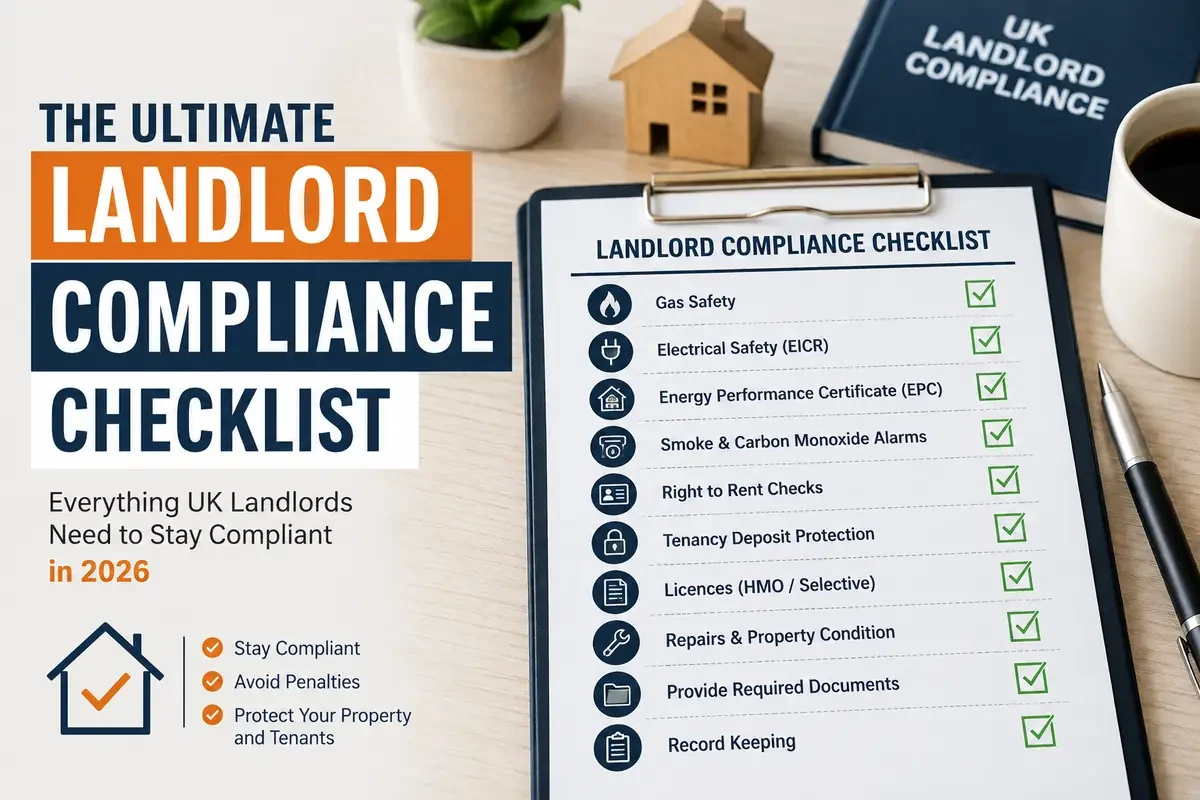
UK Landlord Compliance Checklist 2026: Quick Overview
Landlord compliance is not a one-off exercise. Some responsibilities must be completed before a property is rented, while others need to be monitored and renewed throughout the tenancy.
The following landlord compliance checklist provides a quick overview of the main areas landlords in England should consider in 2026.
Before Letting the Property
- Check whether the property requires a selective, additional or HMO licence from the local council.
- Make sure the property is safe, suitable and fit for habitation.
- Obtain a valid Energy Performance Certificate (EPC) and check that the property meets the applicable minimum energy efficiency requirements.
- Arrange a valid Gas Safety Certificate where gas appliances are present.
- Ensure the property has a satisfactory Electrical Installation Condition Report (EICR).
- Install the required smoke alarms and carbon monoxide alarms and make sure they are working correctly.
- Check whether any additional local authority requirements apply to the property.
Before or At the Start of a Tenancy
- Carry out the required Right to Rent checks where applicable.
- Use an appropriate written tenancy agreement.
- Protect any tenancy deposit in a government-approved tenancy deposit protection scheme within the required timeframe.
- Give the tenant the required deposit prescribed information.
- Provide the tenant with the required safety and tenancy documents.
- Prepare a detailed inventory and schedule of condition, ideally supported by dated photographs.
- Record meter readings and keep evidence of the property’s condition when the tenancy begins.
During the Tenancy
- Keep gas, electrical and other required safety documentation up to date.
- Respond appropriately to repairs and maintenance issues.
- Keep the property safe and fit for occupation.
- Test, maintain and replace required alarms when necessary.
- Follow the correct procedure before entering the property, including giving appropriate notice where required.
- Maintain accurate records of inspections, repairs, certificates and communication with tenants.
- Monitor the expiry dates of licences, certificates and other compliance documents.
When the Tenancy Ends
- Follow the correct legal process if possession of the property is required.
- Carry out a check-out inspection and compare the property’s condition with the original inventory.
- Deal with the tenancy deposit correctly, including providing evidence for any proposed deductions.
- Retain important tenancy and compliance records after the tenancy has ended.
This checklist provides a useful starting point, but the exact requirements will depend on the property, type of tenancy, location and whether additional licensing or HMO regulations apply.
The sections below explain the most important items in more detail, starting with the compliance checks landlords should complete before letting a property.
Before You Let the Property
Landlord compliance should begin before a tenant receives the keys. At this stage, landlords need to establish whether the property can legally be rented, whether any licence is required and whether the necessary safety checks and certificates are in place.
Completing these checks early can help prevent delays, unexpected costs and compliance problems after a tenancy has already started.
Check Whether You Need a Landlord or Property Licence
Depending on the location and type of property, you may need a licence from your local council before letting it.
In England, licensing requirements can include mandatory HMO licensing, additional HMO licensing and selective licensing. While mandatory HMO licensing is governed by national rules, councils can introduce additional or selective licensing schemes covering particular types of properties or designated areas.
This means two similar rental properties in different council areas may have different licensing requirements.
Before advertising or letting a property, check with the relevant local authority to establish:
- Whether the property falls within a licensing area.
- Which type of licence is required, if any.
- Whether an application must be submitted before the tenancy begins.
- What property standards or licence conditions must be met.
- When an existing licence expires and needs to be renewed.
Do not assume that a property is exempt simply because it is not a large HMO. Selective licensing can apply to ordinary privately rented properties within designated areas.
Make Sure the Property Is Safe and Fit to Rent
Landlords have responsibilities relating to the condition and safety of rented accommodation. Before tenants move in, inspect the property carefully and address problems that could affect their health or safety.
This should include checking areas such as heating, ventilation, damp and mould, stairs, windows, doors, sanitation and the general condition of the building.
Particular attention should be given to obvious hazards. A relatively minor maintenance problem can become a much more serious issue if it is ignored after a tenant reports it.
A good pre-tenancy inspection should therefore be more than a cosmetic check. Record any issues identified, arrange the necessary repairs and retain evidence of work completed.
Obtain a Valid Energy Performance Certificate
Most properties that are marketed for rent require a valid Energy Performance Certificate (EPC). The EPC provides information about the property’s energy efficiency and gives it a rating from A to G.
Landlords should check that:
- A valid EPC exists for the property.
- The EPC has not expired.
- The property meets the minimum energy efficiency standard that applies to it, unless a valid exemption applies.
- The required EPC information is made available to prospective and incoming tenants.
An EPC is generally valid for 10 years, but landlords should not rely on memory. Record the expiry date alongside other compliance documents so that it can be reviewed before another tenancy or renewal.
Complete Gas and Electrical Safety Requirements
If the property contains relevant gas appliances, landlords must arrange the required gas safety checks using a suitably qualified Gas Safe registered engineer.
A Gas Safety Record should then be kept and provided to the tenant in accordance with the applicable requirements. Because gas safety checks generally need to be carried out annually, landlords should have a system for monitoring the next due date rather than waiting for the certificate to expire.
Electrical safety is equally important. For most private rented properties in England, the electrical installation must be inspected and tested at intervals specified by the regulations, generally at least every five years, by a qualified person.
The resulting Electrical Installation Condition Report (EICR) should be reviewed carefully. If remedial or further investigative work is required, landlords should make sure it is completed within the required timeframe and retain evidence of the work.
Check Smoke and Carbon Monoxide Alarms
Before the tenancy begins, landlords should also make sure the property has the required smoke and carbon monoxide alarms.
In England, smoke alarms are required on each storey of a rented property that is used wholly or partly as living accommodation. Carbon monoxide alarms are required in rooms used as living accommodation where there is a fixed combustion appliance, subject to the applicable rules and exemptions.
Landlords must ensure the required alarms are working on the first day of a new tenancy.
A sensible approach is to test the alarms during the check-in process and record the result in the inventory or check-in report. This creates evidence that the alarms were present and operational when the tenant took possession.
Once these pre-letting requirements have been addressed, the next stage is making sure the correct checks, documents and procedures are completed when the new tenant moves in.
When a New Tenant Moves In
The start of a tenancy is a particularly important stage for landlord compliance. Even where the property itself is safe and all certificates are up to date, landlords must still complete the correct checks, protect any deposit appropriately and provide tenants with the required information.
Creating a standard move-in process can make these responsibilities easier to manage and provide valuable evidence if questions or disputes arise later.
Carry Out Right to Rent Checks
Landlords in England must check that prospective adult occupiers have the Right to Rent before allowing them to occupy a property as their only or main home, where the statutory scheme applies.
The way a check is carried out will depend on the prospective tenant’s circumstances. This may involve checking acceptable original documents, using the government’s online Right to Rent service or, in certain circumstances, requesting verification through the Home Office Landlord Checking Service.
Landlords should:
- Carry out the check before the tenancy begins.
- Check every adult who will use the property as their only or main home where the scheme applies.
- Follow the correct procedure for the type of Right to Rent evidence presented.
- Keep appropriate records showing that the check was completed.
- Carry out follow-up checks where a person’s Right to Rent is time-limited.
Right to Rent requirements apply in England, rather than across the whole of the UK, which is another reason landlords should check the rules applicable to the location of each property they manage.
Protect the Tenancy Deposit Correctly
If you take a tenancy deposit that is required to be protected, it must be placed in a government-approved tenancy deposit protection scheme.
For relevant private tenancies in England, the deposit generally needs to be protected within 30 days of receiving it. The tenant must also receive the required prescribed information within the applicable timeframe.
Deposit compliance should therefore form part of every landlord’s new-tenancy checklist.
Keep evidence showing:
- The amount and date the deposit was received.
- The scheme in which the deposit was protected.
- The date it was protected.
- When and how the prescribed information was provided.
- Copies of the relevant documents supplied to the tenant.
Landlords should also be aware of the legal limits on the amount that can normally be taken as a tenancy deposit under the Tenant Fees Act 2019.
Incorrectly handling a deposit can have significant consequences, including potential financial penalties and complications when seeking possession of a property. It is therefore important to treat deposit protection as a compliance requirement rather than simply an administrative task.
Provide the Required Documents
Starting a tenancy can involve giving the tenant several important documents. Exactly what must be provided will depend on the property and tenancy circumstances, but landlords should establish which documents apply before handing over the keys.
These may include:
- The property’s valid Energy Performance Certificate (EPC).
- The relevant Gas Safety Record where applicable.
- The current How to Rent guide where the legal requirement applies.
- Information relating to the tenancy deposit.
- Other safety, licensing or tenancy information required for the particular property.
Do not simply assume that sending a document means you can prove it was received. Where possible, retain a clear record showing what was provided, when it was provided and how it was delivered.
This could include an email trail, signed check-in documentation or records held within a property management system.
Prepare an Inventory and Keep Records
A detailed inventory is one of the most useful records a landlord can create at the beginning of a tenancy.
The inventory should describe the condition of the property, fixtures, fittings and any landlord-owned contents. Dated photographs or video evidence can make the record considerably stronger.
You should also record practical information such as:
- Gas, electricity and water meter readings.
- The number of keys provided.
- The condition of walls, floors, doors and windows.
- The condition of kitchens and bathrooms.
- Existing marks, damage or defects.
- The condition of any furniture or appliances supplied.
- Confirmation that required alarms were tested at the start of the tenancy.
Where possible, give the tenant an opportunity to review the inventory and confirm its accuracy.
A good inventory does more than help with deposit disputes. Together with certificates, inspection reports, repair records and tenant communications, it forms part of a wider landlord record-keeping system that can help demonstrate how you have managed the property and met your responsibilities.
Once the tenancy is underway, compliance does not stop. Landlords must continue monitoring safety requirements, property condition, repairs and important renewal dates throughout the tenancy.
Your Ongoing Landlord Compliance Responsibilities
Landlord compliance does not end once the tenant has moved in. Throughout the tenancy, landlords need to monitor safety requirements, maintain the property, respond to repair issues and keep accurate records.
A useful approach is to maintain a compliance calendar showing when certificates, inspections, licences and other important requirements are due for renewal.
Landlords should also understand the different landlord safety checks required for rental properties and how frequently each check needs to be completed.
Keep Gas Safety Requirements Up to Date
Where gas safety requirements apply, landlords must ensure that the required gas safety checks continue to be carried out by a Gas Safe registered engineer.
Checks are generally required every 12 months, and landlords should arrange them before the existing deadline passes. Keep copies of each Gas Safety Record and provide them to tenants within the required timescales.
Rather than relying on the tenant or managing agent to remind you, record the next due date and set reminders well in advance.
Monitor Electrical Safety
Electrical safety also needs to be monitored throughout the tenancy.
For most private rented properties in England, the electrical installation must be inspected and tested by a qualified person at least every five years, or sooner where the previous report specifies a shorter interval.
If an EICR identifies remedial or further investigative work, do not simply file the report away. Review what action is required, complete the necessary work within the applicable timeframe and retain written evidence.
Landlords should also take electrical problems reported by tenants seriously. A valid EICR does not remove the need to investigate faults that develop between inspections.
Maintain Smoke and Carbon Monoxide Alarms
Required smoke and carbon monoxide alarms should remain an important part of ongoing property management.
Tenants will normally be expected to test alarms during the tenancy and report faults. However, when a landlord is informed that a required alarm is faulty, the landlord must repair or replace it as soon as reasonably practicable.
Periodic property inspections provide another opportunity to check alarms and record their condition.
Keeping a dated record of alarm checks, reported faults and any replacements can provide useful evidence of responsible property management.
Deal With Repairs and Property Condition
Landlords have legal repairing obligations and should have a clear system for receiving and responding to maintenance reports.
Areas requiring attention may include:
- Heating and hot water systems.
- Electrical installations.
- Gas installations.
- Plumbing and sanitation.
- Roofs, walls, windows and other structural elements.
- Damp, mould and ventilation problems.
- Stairs, handrails and other potential safety hazards.
The urgency of a repair will depend on the nature of the problem. A failed heating system during cold weather, serious electrical fault or significant water leak will usually require much faster action than a minor cosmetic defect.
Keep records of when problems were reported, what action was taken, contractors instructed and when work was completed.
Carry Out Periodic Property Inspections
Routine inspections can help landlords identify maintenance and compliance issues before they become serious.
Inspections may reveal problems such as leaks, condensation, damaged alarms, deterioration of fixtures or repairs that have not previously been reported.
However, owning the property does not give a landlord an unrestricted right to enter it. Landlords should respect the tenant’s right to live in the property without unnecessary interference and follow the appropriate notice and access requirements.
When an inspection is completed, keep a dated record of its findings and follow up on any necessary work.
Keep Accurate Compliance Records
Good record keeping supports almost every area of landlord compliance. Our landlord record keeping guide explains what records landlords should retain, why they matter and how good documentation can help protect you if a compliance issue or tenancy dispute arises.
Rather than storing documents across different email accounts, folders and devices, consider maintaining a dedicated record for each rental property.
This could include:
- Gas Safety Records.
- EICRs and evidence of remedial work.
- EPCs.
- Property and HMO licences.
- Deposit protection records.
- Right to Rent records where applicable.
- Inventories and inspection reports.
- Repair and maintenance invoices.
- Important tenant correspondence.
- Evidence that required documents were provided.
- Records of complaints and how they were addressed.
Keeping these records organised makes it easier to identify upcoming deadlines and demonstrate what action was taken if a compliance issue, council enquiry or tenant dispute arises.
For landlords managing several properties, a simple compliance tracker can be particularly valuable. Record each requirement, its completion date, expiry or renewal date and any action still outstanding.
The next level of compliance can be more demanding where a property is an HMO or falls within a local licensing scheme, as additional standards and licence conditions may apply.
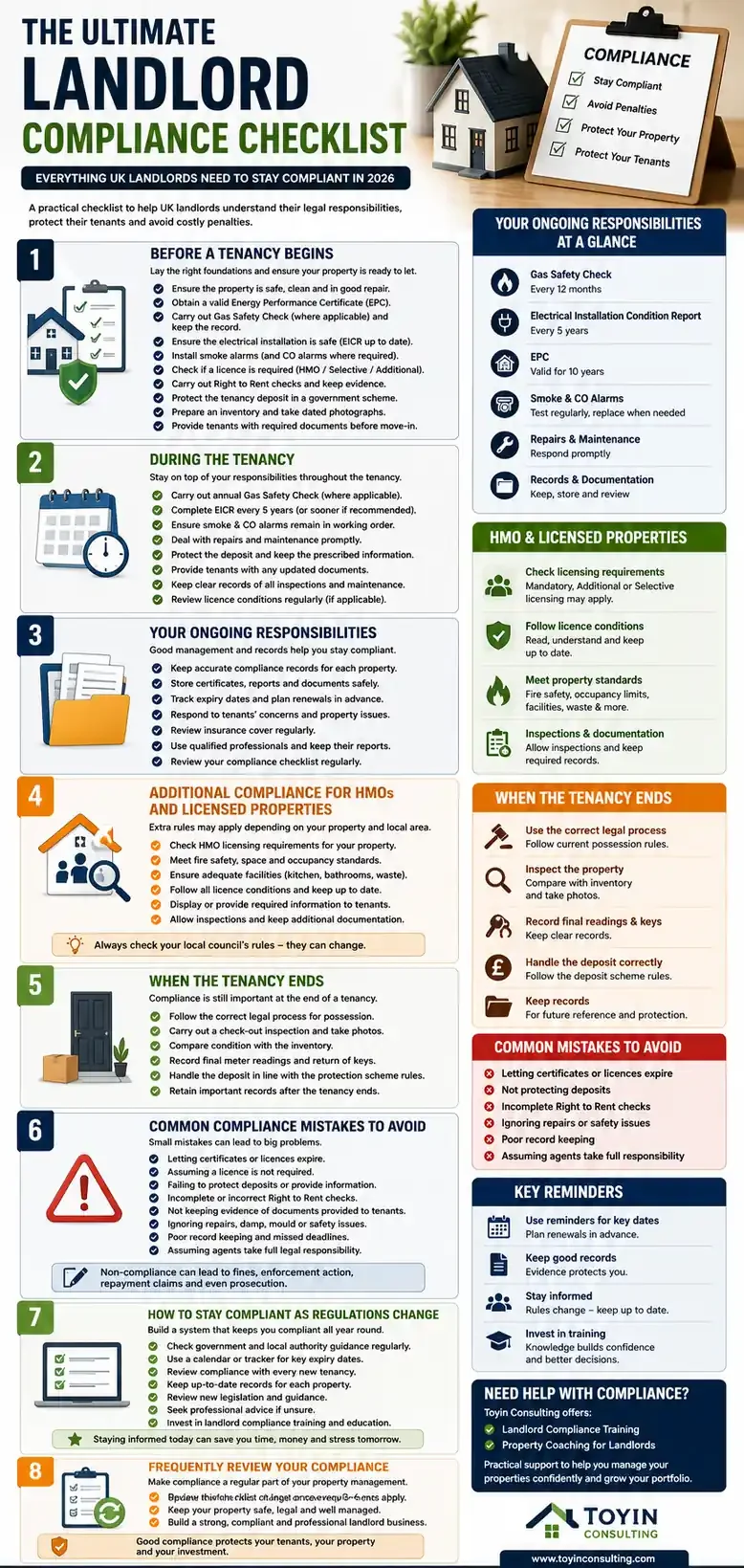
Use the landlord compliance checklist infographic below as a quick reference for the key responsibilities to monitor throughout a tenancy.
Additional Compliance for HMOs and Licensed Properties
Landlords operating a House in Multiple Occupation (HMO) or a property covered by a local licensing scheme may have additional compliance responsibilities beyond those applying to a standard rental property.
In England, certain HMOs require mandatory licensing, while local authorities can also introduce additional HMO licensing and selective licensing schemes. Because requirements can vary between council areas, landlords should always check the rules for the specific location of their property.
Depending on the property and licence, additional requirements may cover:
- Fire doors, fire detection systems and other fire safety measures.
- Minimum bedroom sizes and occupancy limits.
- Adequate kitchen and bathroom facilities for the number of occupants.
- Waste storage and disposal arrangements.
- Management and maintenance standards.
- Displaying or providing certain information to occupants.
- Regular inspections or additional safety documentation.
- Specific conditions imposed as part of the property’s licence.
Landlords should also pay close attention to the maximum number of people permitted to occupy the property. Allowing occupancy beyond the limits specified by a licence can create serious compliance problems.
Check Your Licence Conditions
Obtaining a licence is not the end of the compliance process. The licence may contain conditions that must continue to be met throughout its validity.
Keep a copy of the licence with your property compliance records and review its conditions carefully. Record its expiry date well in advance so there is enough time to prepare and submit any required renewal application.
If you use a letting or managing agent, clarify who is responsible for monitoring each licensing condition. However, landlords should still maintain oversight rather than assuming that appointing an agent automatically removes their own legal responsibilities.
Local licensing schemes can change, expand or be introduced in areas that were previously unaffected. For this reason, checking the relevant council’s current requirements should form part of your regular landlord compliance review, particularly before purchasing or letting another property.
Landlord Compliance When the Tenancy Ends
Compliance remains important when a tenancy comes to an end. Whether the tenant chooses to leave or the landlord needs possession of the property, the correct procedures should be followed and appropriate records retained.
Follow the Correct Legal Process
If you need to recover possession of a property, do not assume that asking the tenant to leave is sufficient. The correct legal process will depend on the tenancy, the circumstances and the legislation in force at the time.
Possession rules are an area of landlord law that can change, so landlords should check the current requirements before serving any notice or beginning possession proceedings.
Where there is uncertainty, obtaining appropriate professional legal advice can help avoid procedural mistakes that could delay possession.
Carry Out a Check-Out Inspection
When the tenant leaves, inspect the property and compare its condition with the inventory and check-in report prepared at the beginning of the tenancy.
Record the condition of the property, take dated photographs where appropriate and note any damage or missing items. Remember that tenants should not normally be charged for fair wear and tear.
You should also record final meter readings and the return of keys.
Deal With the Deposit Correctly
If a protected tenancy deposit is held, deal with it according to the requirements of the relevant deposit protection scheme.
Where deductions are proposed for matters such as damage, cleaning or unpaid rent, keep evidence supporting the amount claimed. The original inventory, check-out report, photographs, invoices and relevant correspondence may all be important if the tenant challenges a deduction.
Any undisputed amount should be returned in accordance with the applicable requirements.
Finally, retain important tenancy and compliance records after the tenant has left. A tenancy may have ended, but questions or disputes can arise later, and organised records can provide valuable evidence of how the property and tenancy were managed.
Common Landlord Compliance Mistakes to Avoid
Many landlord compliance problems are caused not by deliberately ignoring the rules, but by missed deadlines, incomplete records or assumptions about who is responsible for a particular task.
Some of the most common mistakes landlords should watch for include:
- Allowing a Gas Safety Record, EICR, EPC or property licence to expire without taking the required action.
- Assuming a property does not require a licence without checking the local council’s current licensing schemes.
- Failing to protect a tenancy deposit or provide the required information within the applicable timeframe.
- Completing Right to Rent checks incorrectly or failing to retain appropriate evidence.
- Providing required documents to tenants without keeping evidence that they were supplied.
- Failing to respond appropriately to repairs, damp, mould or other reported property-condition issues.
- Treating an HMO in the same way as a standard single-household rental property.
- Keeping poor records of inspections, maintenance, certificates and tenant communications.
- Assuming that appointing a letting or managing agent automatically transfers every compliance responsibility away from the landlord.
The consequences of non-compliance can vary considerably depending on the requirement involved. They may include financial penalties, enforcement action, difficulties recovering possession, repayment claims or, for some offences, prosecution.
For this reason, landlords should not wait until something goes wrong before reviewing their compliance position. A regular compliance review can identify missing documents, upcoming renewal dates and potential problems while there is still time to address them.
If you want to explore these issues in more detail, our guide to common landlord compliance mistakes explains where landlords frequently go wrong and the practical steps that can help reduce those risks.
How to Stay Compliant as Regulations Change
Landlord compliance is not something that should be reviewed once and then forgotten. Regulations, local licensing schemes and guidance can change, while existing certificates and licences also have renewal dates that landlords need to monitor.
A simple compliance system can make this easier. Consider keeping a calendar or digital tracker showing important dates for gas safety checks, EICRs, EPCs, property licences and other recurring requirements. Set reminders well before each deadline so there is enough time to arrange inspections or renewals.
Landlords should also:
- Check government and local authority guidance regularly.
- Review compliance whenever a new tenancy begins.
- Keep up-to-date records for each property.
- Review new legislation to understand whether it affects existing tenancies.
- Check local licensing requirements periodically, particularly when acquiring another property.
- Seek professional advice where a legal or compliance requirement is unclear.
For landlords with multiple properties, these checks become increasingly important. A missed renewal or overlooked requirement across a growing portfolio can create unnecessary financial and legal risk.
Continuing education can also help. Landlord compliance training can provide a more structured understanding of landlords’ responsibilities, while property coaching for landlords can help investors incorporate compliance into their wider approach to managing and growing a property portfolio.
The objective is not simply to react when regulations change. It is to build a property management system that makes ongoing compliance part of normal landlord practice.
Frequently Asked Questions About Landlord Compliance
What does a landlord need to be compliant in the UK?
Landlord requirements depend on where the property is located and the type of tenancy involved. In England, key areas can include gas and electrical safety, EPC requirements, smoke and carbon monoxide alarms, deposit protection, Right to Rent checks, property licensing, repairs and providing tenants with required documents.
What certificates does a landlord need in 2026?
Depending on the property, landlords may need a valid Gas Safety Record, Electrical Installation Condition Report (EICR) and Energy Performance Certificate (EPC). Licensed properties and HMOs may have additional certification, inspection and documentation requirements.
How often does a landlord need a Gas Safety Certificate?
Where the gas safety requirements apply, a gas safety check must generally be carried out every 12 months by a Gas Safe registered engineer. Landlords should keep the relevant records and provide copies to tenants as required.
How often does a landlord need an EICR?
For most privately rented properties in England, electrical installations must be inspected and tested by a qualified person at least every five years, although an earlier inspection may be required if specified in the previous report.
Does every landlord need a property licence?
No. Whether a licence is required depends on the property and its location. Certain HMOs require mandatory licensing, while councils can operate additional HMO licensing or selective licensing schemes. Landlords should check directly with the local authority responsible for the area in which the property is located.
What documents should a landlord give a new tenant?
Depending on the tenancy and property, documents can include the EPC, Gas Safety Record, current How to Rent guide and tenancy deposit prescribed information. Other documents may also be required depending on the circumstances.
How long does a landlord have to protect a tenant’s deposit?
Where the tenancy deposit protection requirements apply in England, the landlord generally has 30 days from receiving the deposit to protect it in a government-approved scheme and provide the required prescribed information.
Is a landlord still responsible for compliance when using a letting agent?
Appointing a letting or managing agent can help with day-to-day compliance administration, but landlords should not assume this automatically removes their own legal responsibilities. The management agreement should clearly establish who is responsible for each task, and landlords should maintain appropriate oversight.
What happens if a landlord is not compliant?
The consequences depend on the requirement that has been breached. Non-compliance can potentially result in financial penalties, enforcement action, restrictions or complications when seeking possession, repayment claims and, in some circumstances, prosecution.
How can landlords keep track of compliance requirements?
A simple landlord compliance tracker can record each property’s certificates, inspections, licence conditions and renewal dates. Setting reminders before important deadlines and maintaining organised records can significantly reduce the risk of something being overlooked.
Landlords should also regularly check current government and local authority guidance, as requirements can change over time.
For a broader picture of compliance across the private rented sector, the UK Landlord Compliance Index examines key compliance trends, challenges and areas landlords should pay particular attention to.
Final Thoughts
Landlord compliance can appear complicated, but having a clear system makes it much easier to manage. The key is to understand which requirements apply to your property, complete the necessary checks at the right time and maintain accurate records of the actions you take.
A landlord compliance checklist can help you stay on top of safety certificates, licensing requirements, tenant documentation, inspections, repairs and renewal dates. More importantly, it can help identify potential problems before they develop into costly compliance issues.
Remember that landlord responsibilities can change as legislation and local authority requirements evolve. Reviewing your compliance regularly should therefore form part of the ongoing management of every rental property.
If you want to strengthen your understanding of your responsibilities, explore Toyin Consulting’s landlord compliance training for practical guidance on managing your properties more confidently and professionally.
And if you need broader support with your property strategy, decision-making or portfolio development, property coaching for landlords can help you build a more structured approach to managing and growing your property business.
Good compliance is not simply about avoiding penalties. It is about protecting your tenants, your properties and your long-term investment.


