
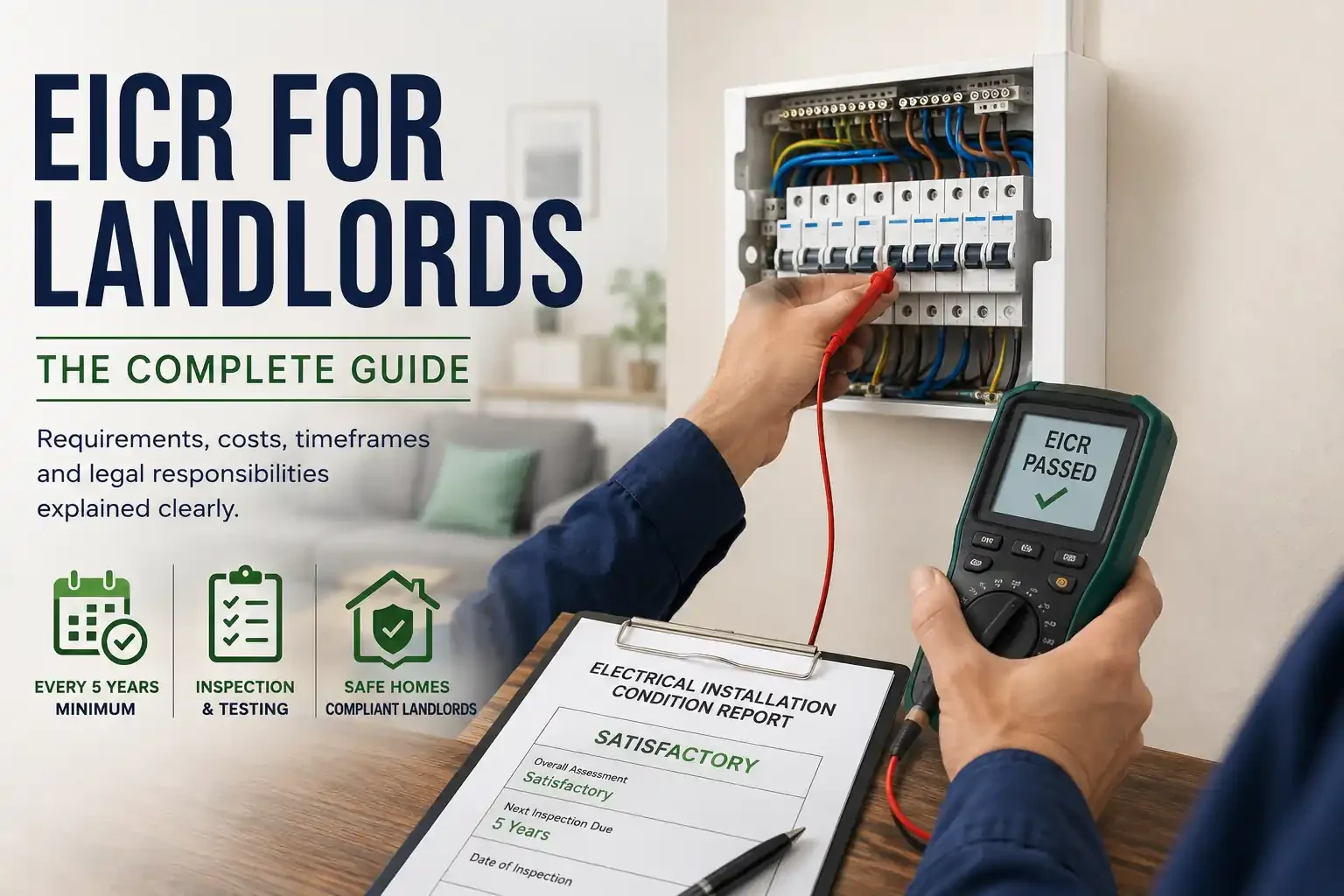
EICR for landlords is an important part of electrical safety and responsible property management. Electrical faults, damaged installations and outdated consumer units can create serious risks for tenants, including electric shock and fire. Failing to meet electrical safety requirements can also expose landlords to enforcement action and significant financial penalties.
An Electrical Installation Condition Report (EICR) is therefore an important part of landlord compliance. It assesses the condition of the fixed electrical installation within a property and identifies defects, deterioration or other issues that could affect electrical safety.
Electrical safety is only one part of the wider landlord compliance requirements that property owners need to understand when renting out a home.
In England, landlords are required to ensure that electrical installations in rented properties are inspected and tested by a qualified person at least every five years, or sooner where the previous inspection specifies an earlier date. Landlords must also provide the appropriate electrical safety report to tenants and take action where the inspection identifies certain electrical hazards.
However, EICR requirements can sometimes be confusing. Landlords may be unsure about how often an inspection is required, what the different EICR codes mean, how quickly remedial work must be completed or how much an inspection is likely to cost.
This guide explains the EICR requirements for landlords, including the electrical safety rules, inspection frequency, typical costs, remedial work and the steps landlords should take to remain compliant.
What Is an EICR?
An Electrical Installation Condition Report, commonly referred to as an EICR, is a formal report produced following an inspection and test of the electrical installation within a property.
The purpose of the inspection is to determine whether the electrical installation is safe for continued use and to identify deterioration, defects or potentially dangerous conditions that may require attention.
An EICR primarily concerns the property’s fixed electrical installation. This can include electrical wiring, sockets, switches, light fittings, consumer units and other permanently connected parts of the electrical system.
During the inspection, the electrician carries out a combination of visual checks and electrical testing. The results are then recorded in the report, together with any observations and recommendations.
If problems are identified, they are normally given classification codes according to their level of risk. Some classifications require the landlord to take remedial action, while others simply recommend improvements.
An EICR should therefore not be viewed as another piece of paperwork to obtain for a rental property. Its primary purpose is to help establish whether the electrical installation remains safe and whether action is required to protect the occupants of the property.
Is an EICR a Legal Requirement for Landlords?
Yes. In England, landlords must comply with legal requirements relating to the electrical safety of their rented properties.
Landlords should refer to the government’s official electrical safety guidance for landlords for the current requirements on electrical inspections, reports, remedial work and providing documentation to tenants.
The Electrical Safety Standards in the Private Rented Sector (England) Regulations 2020 introduced requirements for electrical installations in privately rented homes to be inspected and tested at regular intervals. The electrical safety regime has subsequently been extended to the social rented sector, but for private landlords the EICR requirement is already well established.
For most private landlords, this means arranging for the electrical installation in the property to be inspected and tested by a qualified person at least every five years, unless the previous report specifies that another inspection should take place sooner.
The electrical installation must meet the required safety standards, and landlords are responsible for dealing with certain problems identified during the inspection.
What Are Landlords Required to Do?
In practical terms, landlords should ensure that they:
- Arrange for the property’s electrical installation to be inspected and tested by a qualified person at least every five years, or earlier if required by the previous report.
- Obtain a written report setting out the results of the inspection and the date by which the next inspection should take place.
- Provide a copy of the report to the existing tenant within the required timeframe.
- Provide the appropriate report to a new tenant before they occupy the property.
- Supply a copy to a prospective tenant when requested, within the applicable timeframe.
- Provide a copy to the local authority when formally requested.
- Complete required remedial or further investigative work where the report identifies electrical safety problems.
- Obtain written confirmation that the necessary work has been completed where required.
The EICR should therefore form part of a landlord’s wider compliance system rather than being treated as a one-off certificate that can simply be filed away.
Does Every Rented Property Need an EICR?
The electrical safety regulations apply broadly to residential properties covered by the legislation, but there are specific exclusions.
For example, certain arrangements may fall outside the regulations, including some situations involving landlords sharing accommodation with tenants, long leases, student halls of residence, hostels and refuges, care homes, hospitals and other specified accommodation.
Landlords should not assume that their property is exempt simply because the tenancy or property is unusual. Where there is uncertainty, it is sensible to check the legislation and current government guidance or obtain appropriate professional advice.
There may also be other electrical safety obligations that apply even where a particular letting falls outside these regulations.
The Landlord Remains Responsible
Using a letting or managing agent does not remove the landlord’s underlying legal responsibilities.
An agent may arrange the EICR, communicate with the electrician and organise remedial work on the landlord’s behalf. However, landlords should still maintain appropriate oversight and ensure that inspections are completed on time and that any required work is followed through.
A good compliance system should therefore record the EICR date, expiry or next-inspection date, any observations raised, remedial work completed and supporting documentation.
This is particularly important for landlords with several properties, where relying on memory alone can easily result in inspection dates being missed.
How Often Do Landlords Need an EICR?
Landlords in England must normally have the electrical installation in their rented property inspected and tested at intervals of no more than five years.
However, landlords should not automatically assume that every EICR will remain valid for the full five years.
The report should state when the next inspection and test is recommended. If the qualified person specifies an earlier date, the landlord should arrange the next inspection within that shorter period.
For example, an electrician may determine that the installation is currently satisfactory but recommend another inspection in three years because of its age or condition. In that situation, the landlord should follow the date stated in the report rather than simply waiting five years.
What Happens When an EICR Is Due to Expire?
Landlords should arrange the next inspection before the existing EICR reaches its next-inspection date.
It is good practice not to leave this until the final few days. Booking the inspection early provides time to arrange access, receive the report and deal with any problems that may be discovered.
This is particularly important if the EICR identifies defects requiring remedial work.
Landlords with several rental properties may find it useful to maintain a compliance calendar containing EICR renewal dates alongside other important obligations such as gas safety checks, EPCs, property licensing requirements and relevant alarm checks.
Do You Need a New EICR Every Time the Tenant Changes?
A change of tenant does not automatically mean that a completely new EICR must be obtained.
If the property already has a valid electrical inspection report and the next inspection date has not been reached, the existing report can generally continue to be relied upon, provided there has been no reason to believe the electrical installation is no longer safe.
The landlord must, however, provide the appropriate report to the new tenant before they occupy the property.
If significant electrical work has been carried out, the installation has been damaged, or there are concerns about its condition, landlords should obtain professional advice about whether further inspection or testing is necessary rather than simply relying on the remaining period of the existing report.
Ultimately, the five-year interval should be treated as a maximum inspection period, not a guarantee that every installation can safely wait five years between inspections.
What Does an EICR Inspection Check?
An EICR inspection assesses the condition and safety of the fixed electrical installation within a rental property. The aim is to identify deterioration, damage, defects or other conditions that could put tenants or the property at risk.
The inspection is more comprehensive than simply checking whether lights and sockets work. A qualified person will inspect and test appropriate parts of the electrical installation to determine whether it is safe for continued use.
Areas commonly assessed during an EICR include:
- The consumer unit or fuse box.
- Fixed electrical wiring and circuits.
- Electrical sockets and switches.
- Light fittings and associated circuits.
- Earthing and bonding arrangements.
- Protective devices, including RCD protection where applicable.
- Signs of damage, deterioration or overheating.
- Potential electric shock or fire risks.
- Defective electrical work or unsuitable alterations.
- Whether parts of the installation may require further investigation.
The electrician will also carry out appropriate electrical tests to assess the condition and performance of the installation.
Electrical inspections should also form part of a wider programme of landlord safety checks covering the different areas landlords need to monitor throughout a tenancy.
Does an EICR Check Electrical Appliances?
An important distinction for landlords is that an EICR primarily covers the electrical installation, rather than every portable electrical appliance provided with the property.
Items such as kettles, televisions, toasters and other portable appliances are generally outside the scope of the EICR itself.
However, landlords still have responsibilities to ensure that electrical equipment they provide is safe. Depending on the property and circumstances, landlords may therefore use visual inspections, maintenance procedures and, where appropriate, portable appliance testing (PAT) as part of their wider electrical safety approach.
An EICR and PAT should not be treated as interchangeable. They address different aspects of electrical safety.
What Happens After the Inspection?
Following the inspection and testing, the landlord receives an Electrical Installation Condition Report detailing the findings.
The overall result will indicate whether the electrical installation is considered satisfactory or unsatisfactory for continued use.
Where defects or potential hazards are found, the electrician records observations using recognised classification codes. These codes are particularly important because they help determine the seriousness of the problem and whether remedial work or further investigation is required.
Landlords should therefore read the complete EICR rather than looking only at the overall result or next inspection date.
Understanding classifications such as C1, C2, C3 and FI is essential because some findings require prompt action to keep the property compliant and safe.
Understanding EICR Codes: C1, C2, C3 and FI
One of the most important parts of an Electrical Installation Condition Report is the classification code given to any problem identified during the inspection.
These codes indicate the seriousness of an observation and help landlords understand whether immediate action, remedial work or further investigation is required.
The main EICR classification codes landlords are likely to encounter are C1, C2, C3 and FI.
C1 – Danger Present
A C1 classification means that danger is present and there is a risk of injury.
This is the most serious EICR classification. Where possible, the person carrying out the inspection may take immediate action to remove or reduce the danger.
Examples could include exposed live electrical parts or another defect presenting an immediate electrical hazard.
A C1 observation should never be ignored. The landlord should arrange for the problem to be made safe and properly rectified as a priority.
C2 – Potentially Dangerous
A C2 classification means that the condition is considered potentially dangerous and urgent remedial action is required.
The problem may not present the same immediate danger as a C1 observation, but the installation does not provide an acceptable level of electrical safety.
A report containing a C1 or C2 classification will generally be considered unsatisfactory, requiring the landlord to arrange appropriate remedial work.
C3 – Improvement Recommended
A C3 classification means that improvement is recommended.
Unlike C1 and C2, a C3 observation does not by itself mean that the electrical installation is considered unsatisfactory.
It highlights an aspect of the installation that could be improved to enhance electrical safety.
Landlords should therefore take C3 observations seriously, particularly when planning maintenance or refurbishment, but a C3 does not carry the same remedial requirement as a C1 or C2 classification under the electrical safety regulations.
FI – Further Investigation Required
FI means that further investigation is required without delay.
The electrician may have identified something that cannot be fully assessed during the initial inspection but could potentially present a safety concern.
Further investigation is therefore necessary to determine the nature and extent of the problem.
For landlords, an FI classification should not be treated as an optional recommendation. Where the report indicates that further investigative work is required, this needs to be addressed within the applicable regulatory timeframe.
What Makes an EICR Unsatisfactory?
An EICR will generally be considered unsatisfactory where it contains one or more C1, C2 or FI observations.
For landlords, the key distinction can be summarised as follows:
| EICR Code | Meaning | Typical Landlord Response |
|---|---|---|
| C1 | Danger present | Immediate action required |
| C2 | Potentially dangerous | Urgent remedial action required |
| C3 | Improvement recommended | Consider improvement; does not by itself make the EICR unsatisfactory |
| FI | Further investigation required | Investigation required without delay |
Landlords should avoid trying to interpret technical observations themselves or deciding that an identified defect is not important. If anything on an EICR is unclear, ask the qualified person who carried out the inspection to explain the finding and what work is required.
Most importantly, receiving an unsatisfactory EICR does not mean the compliance process is finished. The landlord must respond appropriately to the findings and, where required, arrange remedial or investigative work within the prescribed timeframe.
What Happens If an EICR Is Unsatisfactory?
An unsatisfactory EICR should not be ignored or simply filed away. If the report identifies electrical safety problems requiring remedial work or further investigation, the landlord must take appropriate action.
Under the electrical safety regulations in England, where the report identifies C1, C2 or FI observations, the landlord must ensure that the required further investigative or remedial work is carried out by a qualified person.
How Long Does a Landlord Have to Complete EICR Remedial Work?
Required remedial or further investigative work must generally be completed within 28 days of the inspection and testing, or within a shorter period if the report specifies one.
For example, if the report requires particular work within 14 days, the landlord should follow that shorter timeframe rather than assuming that the full 28 days is available.
A C1 issue indicating that danger is present will naturally demand much more urgent attention. Where an immediate electrical danger exists, it should be made safe without delay.
What Should Landlords Do After the Work Is Completed?
Once the required work or further investigation has been completed, the landlord should obtain written confirmation from the qualified person that the necessary work has been carried out and that the relevant electrical safety requirements have been met, or that further work is required.
The landlord must then provide the required documentation to the tenant and, where applicable, the local housing authority within the prescribed timeframe.
Keeping these records is extremely important. A landlord should ideally retain:
- The original EICR.
- Quotes or instructions for remedial work.
- Invoices for completed electrical work.
- Electrical certificates where applicable.
- Written confirmation that the required work has been completed.
- Evidence showing when documents were supplied to the tenant.
This creates a clear compliance trail if questions arise later.
Do You Need Another Full EICR After Remedial Work?
Not necessarily. An unsatisfactory report does not automatically mean that the landlord must pay for an entirely new EICR.
Depending on the work required, the electrician may provide appropriate certification or written confirmation demonstrating that the identified defects have been rectified and the required safety standard has been achieved.
Landlords should ask the qualified electrician what documentation will be provided after the remedial work and retain it together with the original EICR.
The key is not simply to obtain a report. The purpose of the EICR process is to identify electrical risks and ensure that required problems are properly addressed.
How Much Does an EICR Cost for Landlords?
There is no fixed statutory price for an EICR. The amount a landlord pays will depend on factors such as the size of the property, number of electrical circuits, location, accessibility and complexity of the electrical installation.
As a broad guide, landlords might expect an EICR for a typical rental property to cost approximately £100 to £300, although prices can be lower or considerably higher depending on the property and contractor.
A small one-bedroom flat with a relatively straightforward electrical installation, for example, may cost less to inspect than a large house or HMO containing numerous circuits and electrical installations requiring testing.
What Can Affect the Cost of an EICR?
Several factors can influence the final price, including:
- Property size: Larger properties generally take longer to inspect and test.
- Number of circuits: An installation with more circuits can require additional testing.
- Type of property: Flats, houses and HMOs can have different levels of electrical complexity.
- Location: Electrician labour rates vary across the UK, with costs often higher in London and parts of the South East.
- Condition of the installation: Older or altered electrical systems may require more investigation.
- Accessibility: Difficult-to-access consumer units, sockets or other parts of the installation can increase the time required.
- Contractor pricing: Electricians may charge a fixed EICR fee or calculate the price according to the property and number of circuits.
Landlords with several properties may sometimes be able to agree portfolio pricing with an electrical contractor, although price should not be the only consideration when choosing who carries out the inspection.
Does the EICR Price Include Remedial Work?
Usually, the quoted price for an EICR covers the inspection, testing and production of the report. It should not automatically be assumed to include the cost of repairing defects discovered during the inspection.
If the property receives an unsatisfactory report, the landlord may therefore face additional costs for remedial work.
The amount can vary significantly. A relatively minor defect may be inexpensive to correct, whereas problems involving an ageing consumer unit, damaged wiring or more extensive electrical work could cost considerably more.
Landlords should therefore ask what is included when obtaining an EICR quotation and whether any remedial work will be quoted separately.
Should Landlords Choose the Cheapest EICR?
Price is naturally important when managing the costs of a rental property, but choosing an electrician purely because they provide the cheapest quotation can be a false economy.
An EICR is a safety inspection and an important compliance document. Landlords should focus on ensuring that the person carrying out the inspection is appropriately qualified and competent to undertake electrical inspection and testing.
It is also sensible to obtain a clear written quotation explaining the scope of the inspection and any additional charges that could arise.
For landlords budgeting over the long term, EICR costs should be treated as part of the property’s normal compliance and maintenance expenditure, rather than as an unexpected cost every few years.
Who Can Carry Out an EICR?
An EICR should be carried out by a qualified person who is competent to undertake electrical inspection and testing.
For landlords, this means it is important not simply to hire someone because they describe themselves as an electrician. Electrical installation condition reporting requires appropriate knowledge, experience and competence to inspect the installation, carry out the necessary tests, identify defects and correctly interpret the results.
Government guidance recommends that landlords ensure the person carrying out the inspection and testing has the appropriate qualifications and competence.
One way to help find a suitable professional is to use the Registered Competent Person Electrical register or choose an electrician who belongs to an appropriate electrical industry registration or certification scheme.
What Should a Landlord Check Before Hiring an Electrician?
Before arranging an EICR, landlords should consider checking:
- Whether the electrician is appropriately qualified and competent to carry out periodic inspection and testing.
- Their experience of carrying out EICRs on residential rental properties.
- Whether they have appropriate insurance.
- What the quoted price includes.
- Whether a written EICR will be provided following the inspection.
- How any required remedial work will be reported and quoted.
Landlords should also keep records of the electrician or contractor used, together with the EICR and any subsequent certificates or written confirmation relating to remedial work.
Ultimately, an EICR is not simply a document needed for a compliance file. The quality of the inspection matters because landlords are relying on it to identify potentially serious electrical safety risks within their properties.
Who Must Receive a Copy of the EICR?
Obtaining an EICR is only part of a landlord’s responsibility. Landlords must also make sure that copies of the electrical safety report are provided to the appropriate people within the required timeframes.
Keeping clear records of when reports were supplied can also help demonstrate compliance if there is a dispute or a local authority requests evidence.
Existing Tenants
Once an electrical inspection and test has been completed, the landlord must provide a copy of the report to each existing tenant within 28 days of the inspection and testing.
Where possible, landlords should retain evidence that the document was provided, such as an email or an appropriate record through their property management system.
New Tenants
For a new tenancy, the landlord must provide the new tenant with a copy of the most recent electrical safety report before the tenant occupies the property.
This makes the EICR an important part of the documentation landlords should prepare when setting up a new tenancy.
Keeping EICRs, remedial certificates and evidence of when documents were supplied should form part of a landlord’s wider landlord record keeping system.
Prospective Tenants
A prospective tenant can also request a copy of the most recent EICR.
When such a request is made, the landlord must provide the report within 28 days of receiving the request.
Local Housing Authority
The local housing authority can request a copy of the EICR from the landlord.
Where a formal request is made under the regulations, the landlord must provide the report within seven days of receiving the request.
This is one reason landlords should keep their compliance records organised and readily accessible rather than relying on an electrician or managing agent to retain the only copy.
The Electrician Carrying Out the Next Inspection
Landlords should retain a copy of the report until the next electrical inspection is due.
The previous report should then be supplied to the person carrying out the next inspection and test. This can provide useful information about the history and condition of the electrical installation.
A simple record-management system can make this much easier. Each rental property should have a compliance file containing the current EICR, previous reports where appropriate, evidence of remedial work and the date of the next required inspection.
For landlords managing multiple properties, maintaining these records centrally can significantly reduce the risk of missed renewal dates, lost certificates or incomplete compliance evidence.
EICR Requirements for HMOs
Landlords of Houses in Multiple Occupation (HMOs) also need to pay particular attention to electrical safety. HMOs can have higher levels of occupancy and greater demands placed on electrical installations, making effective inspection and maintenance especially important.
In England, an HMO that falls within the scope of the electrical safety regulations must have its electrical installation inspected and tested by a qualified person at least every five years, or sooner if the previous report requires an earlier inspection.
Landlords should also be aware that HMOs are subject to additional management and, in many cases, licensing requirements. Depending on the type of HMO and its location, the local authority may impose licence conditions or other requirements relating to electrical safety.
Additional Electrical Safety Considerations for HMO Landlords
Because several occupants may be using electrical equipment simultaneously, HMO landlords should take a proactive approach to electrical safety.
This can include:
- Keeping the current EICR and remedial-work records readily available.
- Acting promptly when tenants report damaged sockets, switches or other electrical problems.
- Regularly checking communal areas for visible electrical damage.
- Ensuring electrical work is carried out by appropriately competent contractors.
- Checking any additional electrical requirements attached to the property’s HMO licence.
- Keeping appropriate records for electrical appliances supplied by the landlord.
Landlords should not assume that obtaining an EICR automatically satisfies every electrical obligation associated with an HMO.
Where a property requires an HMO licence, it is sensible to check the specific licence conditions and local authority requirements alongside the national electrical safety regulations.
This is particularly important because licensing requirements and enforcement practices can vary between local authority areas. Maintaining both a valid EICR and an organised compliance record can make it much easier for an HMO landlord to demonstrate that electrical safety is being properly managed.
What Happens If a Landlord Does Not Have a Valid EICR?
Failing to comply with electrical safety requirements can expose a landlord to enforcement action as well as create serious safety risks for tenants.
Local housing authorities are responsible for enforcing the electrical safety regulations. Where a landlord breaches their duties, the authority has powers to take action.
Financial Penalties for EICR Non-Compliance
Under the current electrical safety regime in England, a local housing authority can impose a financial penalty of up to £40,000 for a breach of specified duties under the regulations.
This makes it particularly important for landlords to avoid treating an expired or missing EICR as a minor administrative issue.
Potential compliance failures could include failing to arrange the required inspection and testing, failing to carry out required remedial work, or failing to provide documentation when required.
Local Authorities Can Arrange Remedial Work
Enforcement is not limited to financial penalties.
Where urgent remedial action is required and the relevant legal conditions are met, a local authority can arrange for work to be carried out and may seek to recover the reasonable costs from the landlord.
The financial consequences of non-compliance can therefore extend beyond a penalty itself.
An EICR Is Only Part of Electrical Compliance
Landlords should also remember that simply having an EICR document does not necessarily mean they are compliant.
For example, a landlord could have an EICR on file but still have a problem if:
- The report has passed its required reinspection date.
- The report is unsatisfactory and required remedial work has not been completed.
- Further investigation identified by the report has not been undertaken.
- Required documentation has not been supplied to the relevant parties.
- Electrical safety concerns have arisen since the inspection and have been ignored.
The objective is to maintain a safe electrical installation, rather than merely to possess a certificate.
For this reason, landlords should monitor EICR dates, read inspection reports carefully, act promptly on required work and retain evidence demonstrating what action was taken.
A well-maintained compliance record can help protect tenants while also allowing the landlord to demonstrate that electrical safety responsibilities have been taken seriously.
Allowing certificates to expire or failing to act on required remedial work are examples of common landlord compliance mistakes that can expose property owners to unnecessary risk.
EICR Landlord Checklist
Managing EICR compliance becomes much easier when landlords follow a consistent process for every rental property. Rather than waiting until an inspection is about to expire, electrical safety should form part of the property’s ongoing compliance schedule.
EICR dates should ideally be monitored alongside the other legal and administrative duties included in a comprehensive landlord compliance checklist.
Use this checklist as a practical starting point:
- Check the date of the property’s current EICR and when the next inspection is required.
- Arrange a new inspection before the existing inspection period expires.
- Use a qualified and competent person to carry out the inspection and testing.
- Keep a complete copy of the EICR in the property’s compliance records.
- Check whether the report is satisfactory or unsatisfactory.
- Review any C1, C2, C3 or FI observations rather than simply filing the report.
- Arrange required remedial work or further investigation within the applicable timeframe.
- Obtain written confirmation or appropriate certification for completed remedial work.
- Provide the EICR and subsequent required documentation to tenants within the relevant time limits.
- Give a new tenant the current report before they occupy the property.
- Respond promptly if the local housing authority requests the report.
- Retain the report until the next inspection and provide it to the person carrying out the subsequent inspection.
- Keep evidence showing when reports and other required documents were supplied.
- Record the next EICR date in a compliance calendar or property management system.
- For HMOs or licensed properties, check whether the local authority or licence imposes any additional electrical safety requirements.
For landlords managing several rental properties, it is particularly useful to keep a central compliance tracker covering EICRs alongside gas safety certificates, EPCs, property licences, alarm requirements and other recurring obligations.
The goal is not simply to pass an electrical inspection every few years. A structured approach helps landlords identify problems early, maintain safer properties and reduce the risk of important compliance deadlines being overlooked.
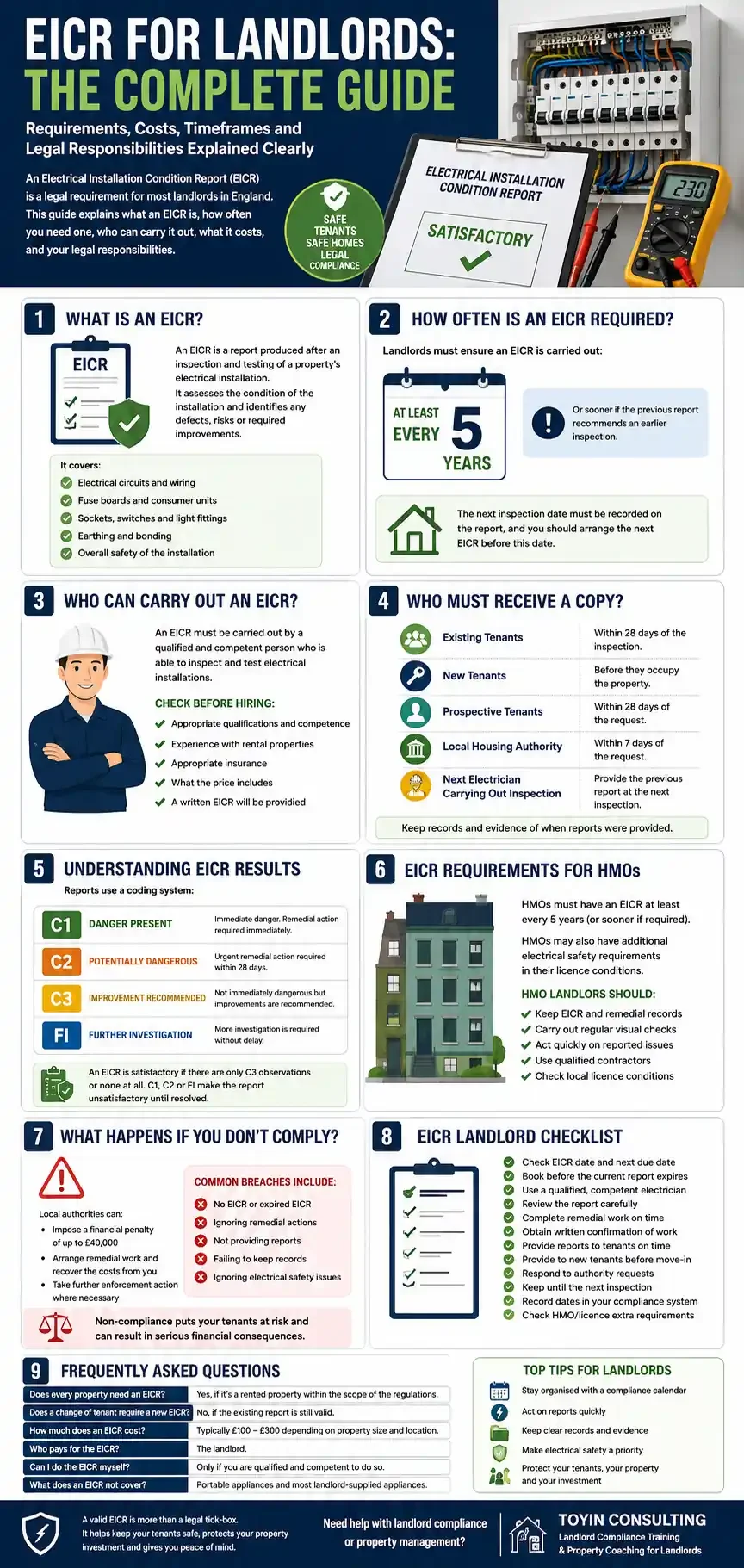
Frequently Asked Questions About EICRs for Landlords
What does EICR stand for?
EICR stands for Electrical Installation Condition Report. It is produced following an inspection and testing of a property’s fixed electrical installation to assess whether it is safe for continued use.
Is an EICR a legal requirement for landlords?
For properties within the scope of the electrical safety regulations in England, landlords must ensure that the electrical installation is inspected and tested by a qualified person at intervals of no more than five years, or sooner where the previous report requires it.
How often does a landlord need an EICR?
An EICR is generally required at least every five years. However, if the report specifies an earlier date for the next inspection and test, the landlord should follow that shorter interval.
Do I need a new EICR for every new tenant?
Not automatically. If there is already a valid EICR and the required next-inspection date has not been reached, a change of tenant does not in itself require another full inspection. The current report must, however, be provided to the new tenant before they occupy the property.
How long does an EICR take?
The time required varies according to the size and complexity of the property, the number of circuits, accessibility and the condition of the electrical installation. A straightforward flat may take less time than a large house or HMO with a more complicated installation.
Can a landlord carry out their own EICR?
An EICR must be carried out by a qualified person who is competent to undertake the required electrical inspection and testing. Unless the landlord has the appropriate qualifications and competence, they should appoint a suitable electrical professional.
What happens if an EICR is unsatisfactory?
An unsatisfactory EICR commonly contains C1, C2 or FI observations. The landlord must arrange the required remedial work or further investigation within the applicable timeframe — generally within 28 days, or sooner where the report specifies a shorter period.
Does a C3 mean the EICR has failed?
No. A C3 classification means improvement is recommended and does not, by itself, make an EICR unsatisfactory. Nevertheless, landlords should consider C3 recommendations when planning future maintenance and improvements.
Does an EICR cover appliances?
An EICR primarily examines the property’s fixed electrical installation. Portable electrical appliances are generally outside its scope. Landlords should manage the safety of any electrical appliances they provide separately.
How much does a landlord EICR cost?
There is no fixed price. Costs depend on factors including property size, location, number of circuits and the complexity of the installation. A typical residential EICR may cost around £100 to £300, although actual quotations can fall outside this range.
Who pays for an EICR in a rented property?
The landlord is responsible for meeting their obligations under the electrical safety regulations, including arranging the required inspection and testing. The cost should therefore normally be treated as part of the landlord’s compliance and property-management expenditure.
Can a landlord be fined for not having an EICR?
Yes. Local housing authorities have enforcement powers, and under the current electrical safety regime in England a landlord can face a financial penalty of up to £40,000 for specified breaches of the regulations.
Should landlords keep old EICRs?
Yes. Good record keeping can help demonstrate the history of the electrical installation and the action taken following previous inspections. The current report should also be retained until the next inspection and supplied to the person carrying out that inspection.
An organised EICR process helps landlords do more than satisfy a regulatory requirement. It provides an ongoing record of the condition of the property’s electrical installation and helps ensure that identified safety problems are dealt with appropriately.
Final Thoughts
An EICR is an essential part of managing a safe and compliant rental property. For landlords, the responsibility goes beyond arranging an electrical inspection every five years. It also means understanding the findings, completing required remedial work within the correct timeframe, providing reports to tenants when required and keeping accurate records.
A well-managed electrical safety process helps protect tenants from avoidable risks while reducing the landlord’s exposure to enforcement action, unexpected costs and compliance problems.
The simplest approach is to make EICR management part of a wider landlord compliance system, with important inspection dates recorded in advance and supporting documentation kept together for each property.
At Toyin Consulting, we help landlords better understand their responsibilities and develop a more structured approach to managing rental properties. Explore our landlord compliance training and property coaching for landlords if you want practical support with compliance, property management and making more informed decisions as your portfolio develops.
Disclaimer: This article provides general information and should not be regarded as legal or electrical advice. Regulations and official guidance can change, and requirements may differ depending on the property and circumstances. Landlords should check current government guidance and obtain appropriate professional advice where necessary.


